23 September 2026
Daria Fursova: Full speech by a girl who left the temporarily occupied Crimea
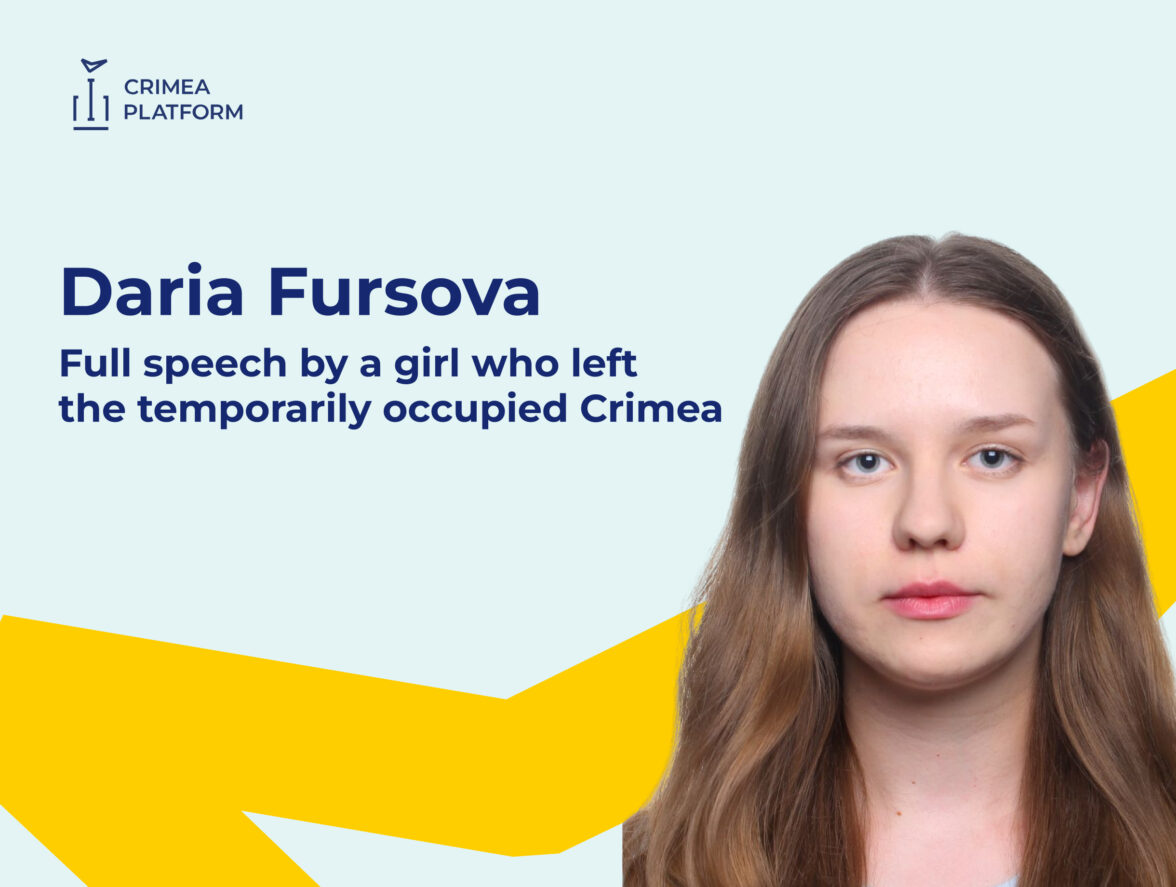
Distinguished Heads of States, Ladies and Gentlemen, dear Participants of the Summit,
It is a great honor to be here today. Thank you for giving me the opportunity to speak — and, I hope, to be heard.
I was born in Simferopol, in Ukrainian Crimea.
When Russia occupied Crimea, I was only 11 years old. One of the most important periods of my life — the time when identity, beliefs, and understanding of the world are formed — took place under the influence of the Russian occupation. Luckily, my parents and sister always reminded me: This is not normal. We are living under occupation. And our future does not belong to the occupier. They gave me the opportunity to choose my own future.
I completed a Ukrainian school remotely, moved to Kyiv, enrolled at a Ukrainian university, and today I study history and work at the War museum.
I was lucky. But most children in occupied Crimea do not have that choice. And that is why we must continue talking about Crimea. Because behind every day of the occupation is a child.
Russia is not only occupying territory. It is trying to shape an entire generation. And we cannot allow a generation of children from Crimea to grow up believing that the occupation is their normal life. This is where Ukraine and our international partners can make a real difference. But we also need to tell them something much simpler: You are not forgotten. Your talents matter. Your future matters. And you are welcome in a free Ukraine and in a free world.
I myself only understood the true meaning of these opportunities after I had left Crimea. How many young people in Crimea today do not even know that these opportunities exist for them? But our goal cannot be just to help people escape the occupation. Our goal is to liberate Crimea. Because Crimea is not just a piece of territory on a map. Crimea is people. Crimea is home.
For me, Crimea is about my childhood, memories, and family. It is the place where my life began, and the place I still call home. That is why it is so difficult for me to hear discussions about “territorial concessions”. When using these words, it is easy to see just lines on a map, or territories that can be transferred from one side to another. But for the people who were born and raised there, it is not territory. It is home.
For millions of Ukrainians, Crimea is not an abstract geopolitical issue. It is a matter of justice.
Today, this Summit is more than a high-level meeting. It is a test of our unity. Will we remain united when the occupation lasts for years? Will we continue to speak about the people whose voices Russia is trying to silence?
But this is also my call to action. A call not just to remember about Crimea. Not just to talk about Crimea, but to act: to support young people from Crimea; to create educational exchanges, internships, grants, and other opportunities for those who have left; to prepare for the reintegration of Crimea. And to firmly support the territorial integrity of Ukraine and our right to return home.
Thank you.
Slava Ukraini!