27 November 2025
Defendants in the Case of the First Dzhankoi Group Illegally Sentenced by Russia to 13–19 Years in Prison
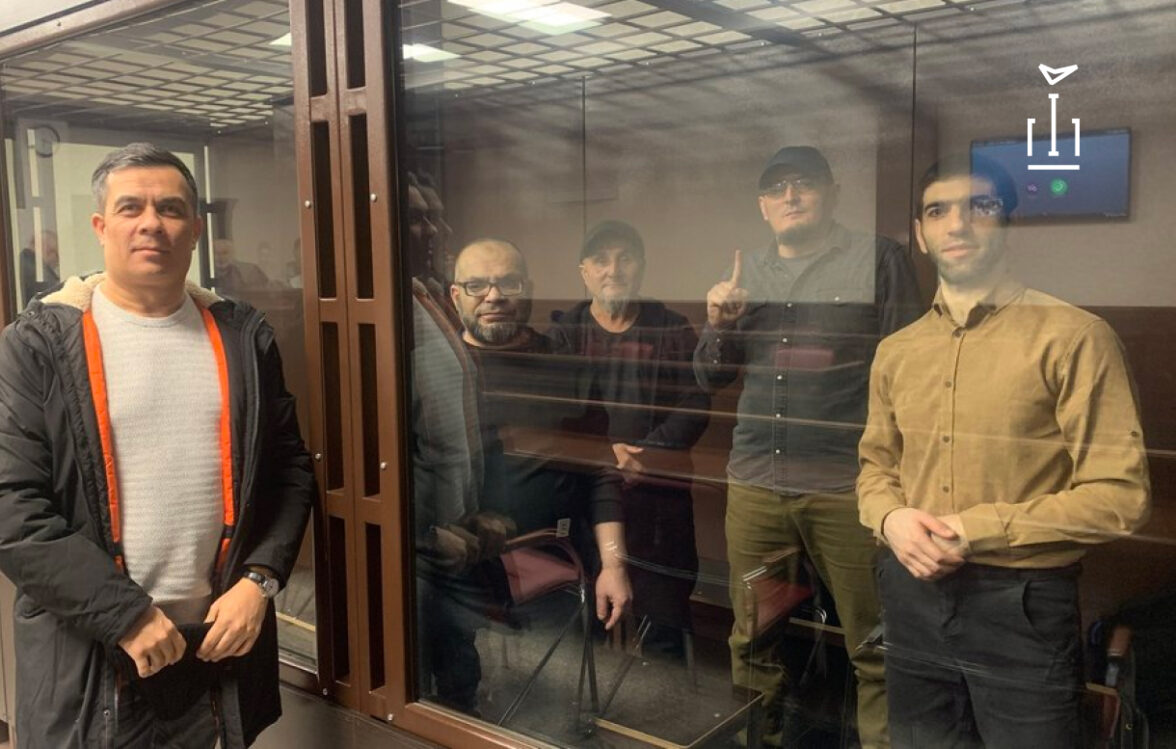
On 26 November, an occupation court in Rostov-on-Don sentenced Crimean journalist Vilen Temerianov and four Crimean Tatar activists in the case of the first Dzhankoi group to lengthy prison terms ranging from 13 to 19 years.
The longest sentence — 19 years — was imposed on activist Enver Krosh. He is to serve the first four years in prison and the remainder of the unlawful term in a high-security penal colony. The Russian court sentenced Edem Bekirov and Rinat Aliyev to 15 years each, journalist Vilen Temerianov to 14 years, and Seitiah Abbozov to 13 years. All the defendants except Krosh were sentenced to three years in prison as part of their terms. Krosh was taken into custody in the courtroom, from where he had participated in the hearing via video link.
The case of the first Dzhankoi group was initiated in August 2022. Enver Krosh was charged with organizing terrorist activities.
Following their unlawful detention, most of the defendants were placed in pre-trial detention, while Seitiah Abbozov was placed under house arrest due to his health condition. Krosh reported that security forces tortured him after the search, demanding the password to his phone. During his transfer to the FSB office, officers reportedly twisted his arms while he was in handcuffs, threw him to the floor, beat him, and covered his mouth and nose with their hands until he began to suffocate. After the torture, Krosh was left with bruises, cuts, scratches, and hematomas.
In their final statements, the defendants denied any involvement in the crimes they were accused of. Enver Krosh stated that he had no connection to terrorism or the seizure of power and called the charges completely absurd. Edem Bekirov said that he and other Crimean Muslims were being tried for allegedly engaging in “terrorist activities,” describing it as yet another standard formulation used against Crimean Tatars since 2014. Lawyer Emil Kurbedinov emphasized that neither the defendants nor their defense expected a fair outcome in such a highly politicized criminal prosecution.
“This injustice leads to a situation where every Muslim, even if they have done nothing illegal, can be arrested at any moment. That is exactly what is now happening in Crimea. Since 2015, I had been under surveillance, although I had done nothing unlawful at the time, yet I was already considered a ‘suspect Muslim.’ In 2022, they broke into my home and conducted a search with numerous violations and planted books that do not bear my fingerprints — neither on the covers nor on the pages,” Vilen Temerianov said in his final statement in court.
Lawyer Emil Kurbedinov also reported numerous violations during the investigation, including the fabrication of evidence, issues with secret witnesses, and the planting of prohibited literature. According to him, the main evidence in the case was an audio recording from 2015 in which prayer and fasting were discussed without any calls for violence. Independent experts established that none of the books admitted as material evidence bore the fingerprints of any of the defendants, yet the court refused to include these findings in the case file.
These sentences constitute yet another deliberate act of unlawful punishment aimed at intimidating the Crimean Tatar people. Ukraine and the international community must continue to exert pressure on Russia, document these crimes, and seek the release of all political prisoners held by the Russian Federation.