21 November 2025
The UN Committee Adopts an Updated Resolution on Human Rights in Occupied Crimea
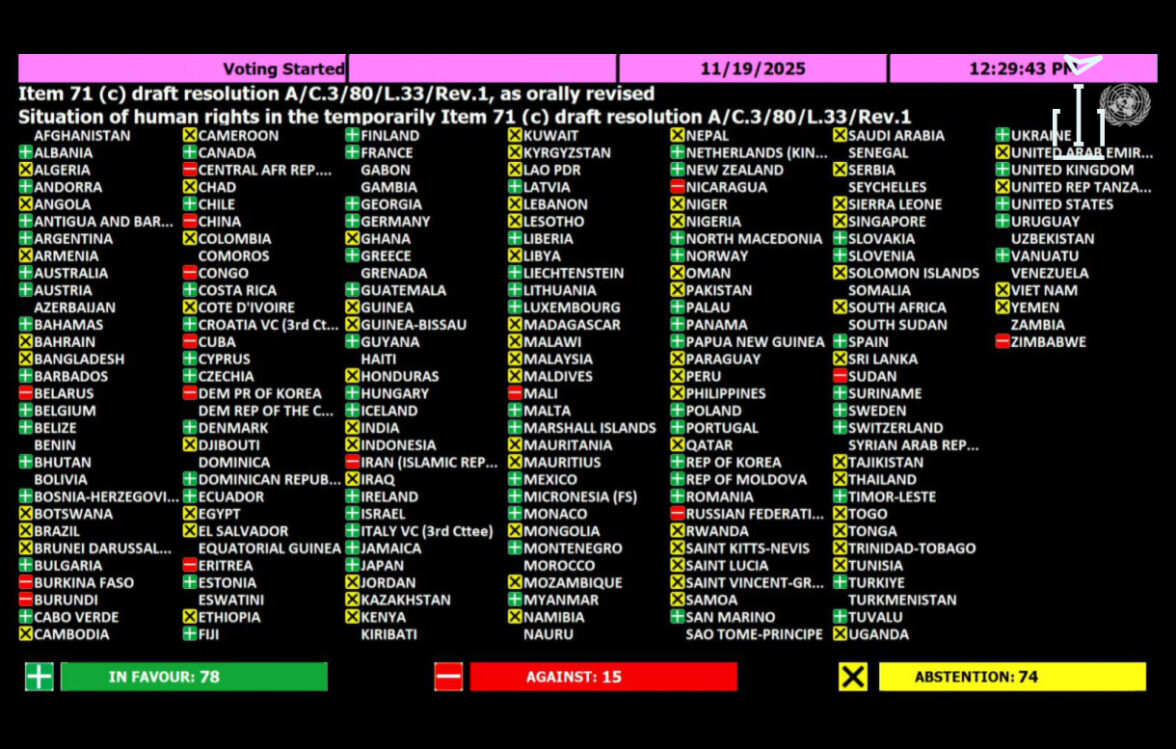
On 19 November, the Third Committee of the UN General Assembly adopted an updated draft of the annual resolution dedicated to the human rights situation in the temporarily occupied territories of Ukraine, including the Autonomous Republic of Crimea and the city of Sevastopol.
Seventy-eight countries supported the document. The following states voted against it: Belarus, Burkina Faso, Burundi, the Central African Republic, China, Congo, the DPRK, Cuba, Eritrea, Iran, Mali, Nicaragua, and the Russian Federation.
This year’s draft resolution states that Russia violates human rights and international humanitarian law, including through repressive practices in the occupied territories, as well as torture, arbitrary detentions, and persecution of journalists, human rights defenders, and representatives of the Indigenous people.
This year, the section addressing torture and other forms of cruel treatment was strengthened, highlighting the systematic abuses committed by the Russian Federation against Ukrainian prisoners of war and unlawfully detained civilians. The document records the findings of international investigations on the abduction, torture, and enforced disappearance of Ukrainians. The resolution also explicitly demands that Russia provide families with complete information regarding the fate and whereabouts of all unlawfully detained persons.
The document also includes the UN Secretary-General’s warning that Russia may be added to the list of countries implicated in conflict-related sexual violence. Russia has already been listed for three consecutive years for grave violations of the rights of Ukrainian children. The resolution is expected to be formally adopted by the UN General Assembly in December.
We express our gratitude to partner states for their consistent attention to the situation in Crimea and for their support, which helps keep the issue of the Russian-occupied peninsula on the international agenda.