24 November 2025
A seminar on Ukrainian children abducted by Russia was held on the sidelines of the Fourth Parliamentary Summit of the Crimea Platform
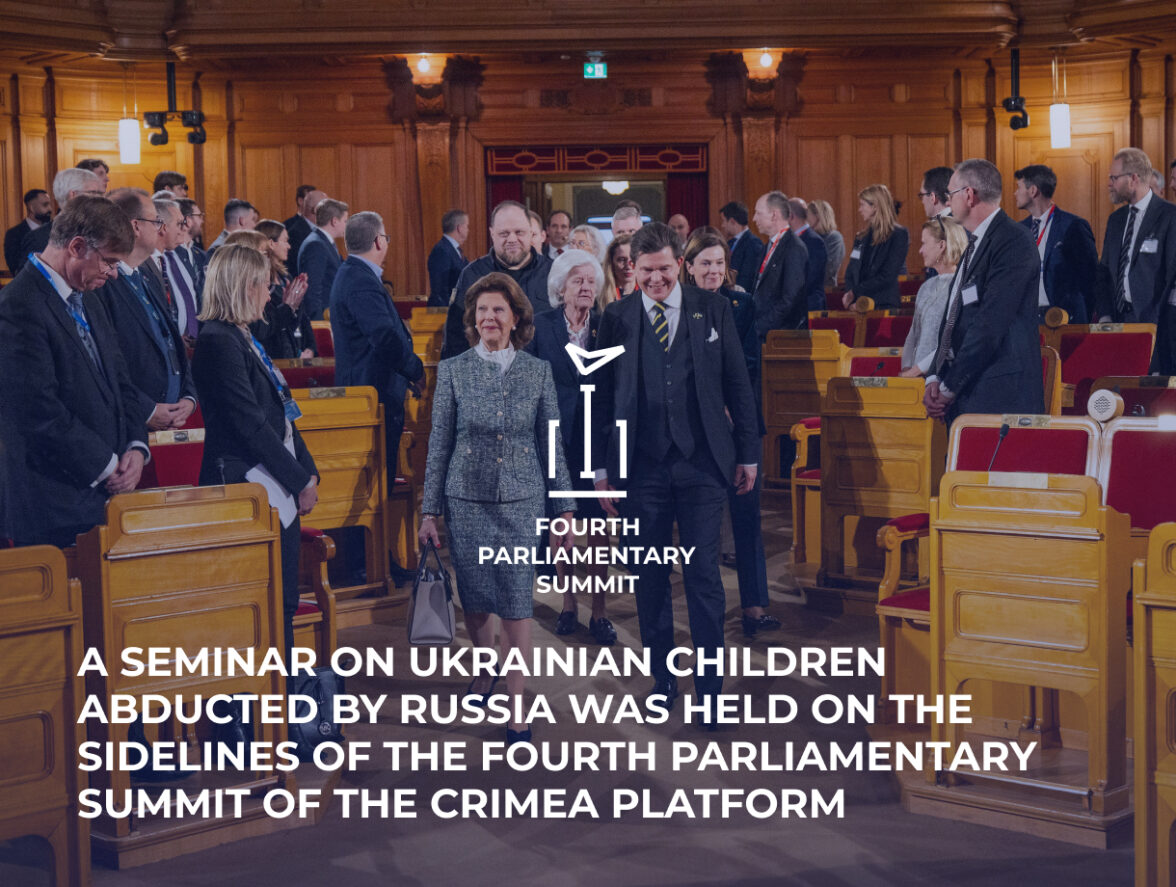
The seminar was attended by Nathaniel Raymond, Representative of Yale University; Thórdís Kolbrún Reykfjörd Gylfadóttir, Member of the Icelandic Althing (Parliament) and Special Envoy of the Council of Europe; Carina Ödebrink, Member of the Swedish Riksdag and Special Representative of the OSCE PA; Olena Khomenko, Member of the Ukrainian Parliament and Chair of the Parliamentary Network on the situation of Children of Ukraine; and Markus Wiechel, Member of the Riksdag and Head of the Swedish delegation to PACE.
The event was moderated by Mark Klamberg, Deputy Director of the Stockholm Centre for International Law and Justice.
Opening remarks to the seminar participants were also delivered by the Speaker of the Riksdag, Andreas Norlén, and the Chairman of the Parliament of Ukraine, Ruslan Stefanchuk.
“Of all the atrocities, of all the crimes of Russia’s brutal war against Ukraine, the kidnapping of thousands of children counts among the most cruel. It is difficult to imagine the suffering and despair experienced by these Ukrainian children and to fathom the extent of their homesickness,” stressed the Speaker of the Riksdag, Andreas Norlén.
To convey the depth of the children’s suffering and homesickness, Andreas Norlén read a poem by Taras Shevchenko to those present. The Speaker of the Riksdag emphasized that Shevchenko, who himself endured a decade of forced exile in Russia, his words provide insight into what is happening in the hearts and minds of the abducted Ukrainian children.
“Since the beginning of the full-scale invasion, according to official data, around 20,000 children have been abducted. In 2025, Russia expanded the network of institutions on its territory and in the temporarily occupied territories of Ukraine. According to studies by Yale University, 210 facilities have been identified to which the Russian Federation transfers abducted Ukrainian children,” reported the Chairman of the Verkhovna Rada of Ukraine, Ruslan Stefanchuk.
Ruslan Stefanchuk stressed that Russia’s actions are tearing Ukrainian families apart, depriving children of their culture, language, and future, and called it cynical that the children are displayed in catalogs as if “for sale.” He called for holding all those involved accountable and urged other states and institutions that have not yet joined the coalition to do so without delay. He noted that consolidating efforts is extremely important for protecting the foundations of the civilized world: freedom, dignity, and the right to a future.
During the seminar, several preliminary reports were also presented to all attendees, which detailed Belarus’s cooperation with Russia in the systematic deportation of Ukrainian children, their forced adoption, re-education, and militarization.
Nathaniel Raymond, the representative of Yale University, continued the seminar. He presented a report on how Russia is re-educating and militarizing Ukrainian children, and also recalled the arrest warrants for Putin and the Russian Commissioner for Human Rights, Maria Lvova-Belova, issued by the International Criminal Court in 2023. He noted that the research succeeded in identifying one of the presidential aircraft used to transport Ukrainian children. The research group transmitted all data to Europol.
“We managed to obtain documents for 106 institutions, which show that they are managed directly by federal agencies in the Russian government, which are subordinated to the Kremlin. This is the largest single abduction of children since the Nazis in the Second World War. And in many elements of this system, you will notice Siberia on the map. They reactivated the Stalin-era Pioneer program for the re-education of children from the Soviet era — and this is no coincidence,” remarked Nathaniel Raymond, the representative of Yale University.
Also during the session, Thórdís Kolbrún Reykfjörd Gylfadóttir, the Special Envoy of the Council of Europe, stated that the abduction and forcible transfer of children is not accidental, but a deliberate, systematic, and strategic crime aimed at rewriting their memories and roots. She stressed that the trauma experienced by the children is not measured in months or years; it reshapes the architecture of a child’s mind and, if left unaddressed, becomes a silent inheritance for the entire nation.
“It has been almost four years since Russia launched its full-scale war of aggression against Ukraine. Four years may feel like a long time for adults, full of meetings, deadlines, and political cycles. But for a child, four years is a lifetime. And while time has moved on for the rest of the world, for the children of Ukraine, time has not moved at all. It has stopped at the moment of rupture, the moment of loss, separation, and fear. The abduction and forcible transfer of children is one of the most devastating wounds inflicted by this war,” said Thórdís Kolbrún Reykfjörd Gylfadóttir.
Carina Ödebring stressed that the situation of the abducted Ukrainian children is more urgent than ever, and the scale and systematic nature of these abductions are unprecedented in modern times. She called on the US government to restore funding to institutions, particularly the Yale University Humanitarian Research Lab, noting that their research sheds light on the scale of the abductions and provides evidence for accountability.
“The capturing of Ukrainian children is a cynical extension of the Russian Federation’s imperialist war. The capturing of Ukrainian children is an attempt to hold the future of Ukraine hostage. We will not let them succeed,” emphasized Carina Ödebring.
Olena Khomenko, in turn, noted that children in the occupied territories live under constant pressure aimed at making them forget their identity: their language is taken away, Ukrainian books disappear from schools, and even a casual Ukrainian word can lead to humiliation. She reported testimony from rescued children who described how teenagers are being prepared for early conscription, issued military conscription orders to 16–17, or asked questions such as: “How do you feel about killing?” and “What do you want to be: a tank operator or a pilot?”
“This is not accidental, but it’s a state policy driven from the very top. The occupying authorities seek to reshape children’s identities, break their trust, and prepare them psychologically and practically for future service in the Russian armed forces,” stressed Olena Khomenko
The event is organised by The Stockholm Institute of Transition Economics (SITE) at the Stockholm School of Economics (SSE) together with the Mission of the President of Ukraine in the Autonomous Republic of Crimea / Office of the Crimea Platform, the Global Coalition of Ukrainian Studies, and with the support of the Embassy of Ukraine in Sweden