05 March 2025
Under the Pretext of “Restoration Work,” Occupiers Destroy an Ancient Fresco in the Bakhchysarai Palace
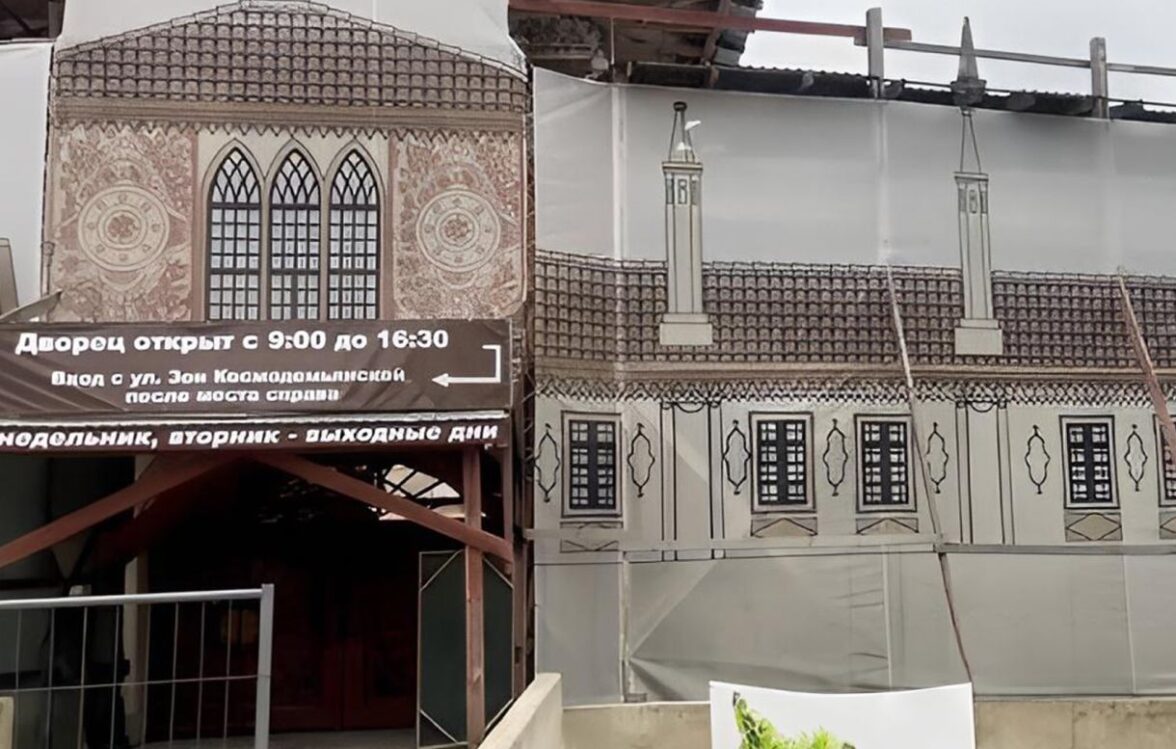
The Russian occupation administration continues its deliberate destruction of the Khan’s Palace, a Crimean Tatar architectural landmark that holds national significance. Under the guise of “restoration work,” an authentic 16th-century wall fresco has been irreversibly destroyed. The fresco had been preserved since the construction of the palace complex by Khan Sahib Geray in 1533.
Until 2014, the palace was properly maintained through planned restoration efforts. From 2003 to 2010, the Crimean branch of the Ukrainian Research Institute carried out conservation measures, including reinforcing plaster with specialized solutions and cleaning surfaces without damaging authentic elements. However, following the occupation of Crimea, the situation has significantly deteriorated.
In the fall of 2017, under the guise of “emergency repair work,” the occupation administration began the deliberate destruction of the Khan’s Palace complex. The Khan’s Mosque suffered severe damage: its roof was completely dismantled, a concrete seismic belt was installed—causing cracks in the walls—and historic stained glass windows were shattered.
The most devastating destruction occurred during the so-called “restoration” of the palace’s authentic elements. The occupation “specialists” removed historic plaster, a blatant violation of conservation standards. According to cultural heritage preservation norms, plaster layers should never be removed, as they contain traces of different construction periods from the 16th to the 19th century. However, the occupiers ignored these principles, further destroying a monument of Ukraine’s Indigenous people.
By the time of the occupation in 2014, all major restoration work on the Khan’s Palace had been completed, and that same year, the complex was included in UNESCO’s Tentative List of World Heritage Sites. The deliberate destruction of this landmark is part of Russia’s systematic policy aimed at erasing the historical memory and identity of the Crimean Tatars while attempting to legitimize the occupation of the peninsula.
These actions by the Russian Federation violate the Fourth Geneva Convention regarding the protection of cultural property in occupied territories, contradict the 1972 UNESCO Convention on the Protection of the World’s Cultural and Natural Heritage, and are part of a broader strategy to displace the Crimean Tatars as Ukraine’s Indigenous people and eliminate their historical heritage.
The international academic community continues to draw attention to the deliberate destruction of Crimea’s cultural heritage under Russian occupation. The publication “The Conversation” recently featured an article by Dr. Olenka Z. Pevny, an art historian and scholar of Ukrainian visual culture at the University of Cambridge. Her article highlights the threat of historical monuments disappearing in Crimea, particularly the Khan’s Palace in Bakhchysarai. Dr. Pevny underscores that the Crimean Peninsula has long been a crossroads of civilizations—from ancient Greek and Roman cities to medieval Genoese fortresses. However, today, the Russian occupation administration is not only oppressing the Indigenous Crimean Tatar population but also erasing its cultural heritage, which forms an integral part of European and global history.
We call on the international community to take a strong stance against Russia’s destruction of Crimean Tatar cultural heritage and to increase pressure on the Russian Federation to prevent the complete ruin of the Khan’s Palace. We demand international condemnation of these actions and the imposition of additional sanctions against individuals and entities responsible for the destruction of historical heritage in the occupied territory. We urge UNESCO and other international organizations to push for independent monitoring of the site’s condition and to hold Russia accountable for violations of international law.
The destruction of the Khan’s Palace is not only a loss for the Crimean Tatar people and Ukraine but also a challenge to the entire international system for the protection of cultural heritage.