29 October 2025
Suppression of the Right to Peaceful Assembly in Crimea: Analysis of the Application of Article 20.2 of the Code of Administrative Offences of the Russian Federation by Occupation Courts
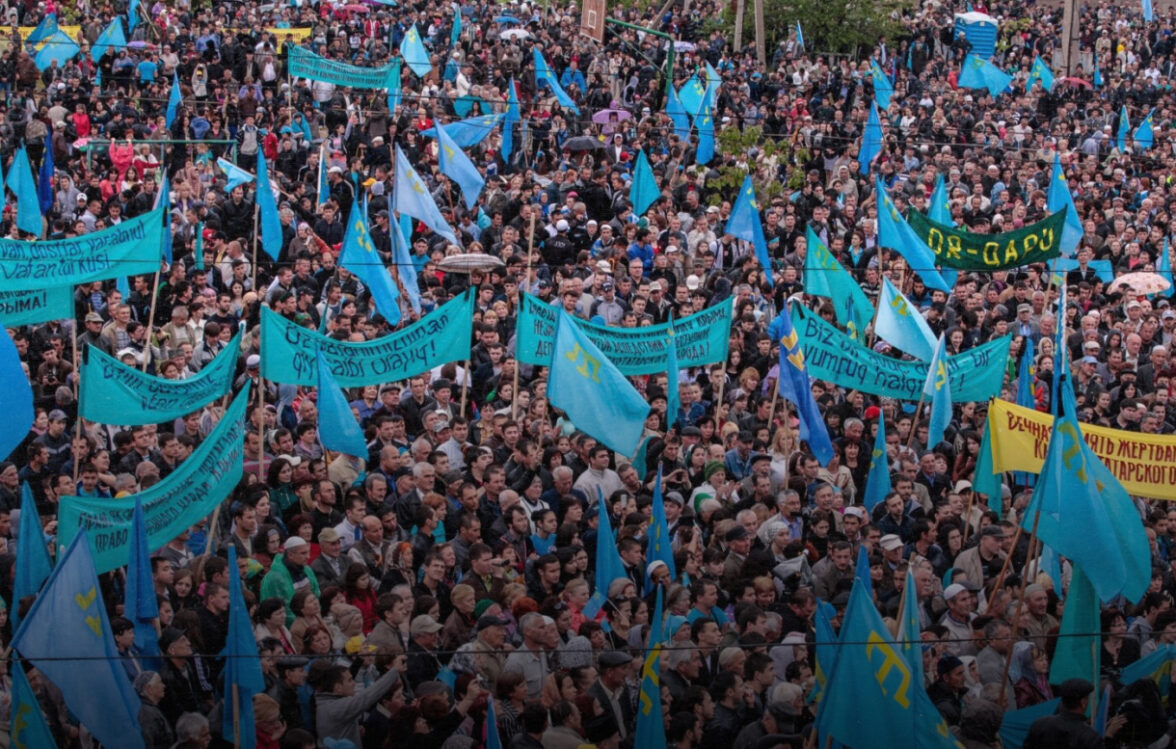
According to available public data, the Russian Federation, in the temporarily occupied territory of Crimea, actively obstructs Ukrainian citizens from exercising their right to peaceful protest, including in support of persons prosecuted by the occupying state on politically motivated charges. It is necessary to analyze the practice of applying the relevant legal provisions.
Article 20.2 of the Code of Administrative Offenses of the Russian Federation (violation of the established procedure for organizing or holding assemblies, rallies, demonstrations, marches, or picketing) is used by the occupying authorities as a punitive instrument to suppress any form of peaceful protest.
As of 22 October 2025, the registers of the so-called “courts” in the temporarily occupied territory of Crimea contain 611 case files compiled under Article 20.2 of the Code. Among them: In 365 cases, rulings on administrative penalties were issued; In 146 cases, materials were returned to the authority that had compiled them; 92 cases were terminated.
In total, 348 individuals were subjected to administrative liability.
Discriminatory practice against Crimean Tatars:
Of the 365 cases in which administrative penalties were imposed, 223 concerned Crimean Tatars, accounting for more than 61% of all instances.
Most active zones of persecution: Proceedings under Article 20.2 most frequently occurred in Bakhchysarai, Simferopol, Dzhankoy, Alushta, and Sudak—regions where politically motivated prosecutions are most commonly recorded.
Types of penalties: For individuals: administrative fines ranging from 10,000 to 20,000 rubles or up to 100 hours of compulsory community service; For officials: fines ranging from 50,000 to 100,000 rubles; For legal entities: fines ranging from 250,000 to 500,000 rubles.
Most frequently applied parts of Article 20.2 of the Code: Part 5 – 180 cases (participation in a public event in violation of established procedures); Part 2 – 102 cases (organization without prior notification); Part 1 – 39 cases (violation by the organizer); Part 6.1 – 27 cases (creating obstacles to infrastructure); Part 3 – 12 cases; Part 8 – 4 cases (repeated offence).
Both opponents and supporters of the occupation have been held accountable, indicating that the provision is used not to maintain public order, but to control society.
After the temporary occupation of the Autonomous Republic of Crimea and the city of Sevastopol, the Russian Federation illegally extended the application of its domestic legislation to this territory, including provisions that restrict the freedom of peaceful assembly: Article 20.2 of the Code of Administrative Offenses of the Russian Federation (Violation of the established procedure for organizing or holding assemblies, rallies, demonstrations, marches, or picketing).
The practice of applying Article 20.2 of the Russian Administrative Code is such that the occupation authorities consider any peaceful assembly not approved by the occupation administration to constitute a “violation of the established procedure.” Violations of this so-called “law” carry administrative penalties for citizens ranging from 10,000 to 20,000 rubles or mandatory community service of up to 100 hours; for officials, fines range from 50,000 to 100,000 rubles; and for legal entities, from 250,000 to 500,000 rubles.
In addition, after the onset of the COVID-19 pandemic and the introduction in April 2020 of the “threat of emergency situation” regime in Crimea, Article 20.6.1 of the Russian Administrative Code (Failure to comply with rules of conduct during an emergency or the threat thereof) began to be applied to participants of peaceful assemblies. The use of this article stems from the occupation authorities’ complete ban on any peaceful gatherings as a measure against the spread of coronavirus, violating international standards on the freedom of assembly, which recognize the right to hold socially significant peaceful assemblies even during pandemics. This provision applies even to solitary pickets, whose participants fully comply with anti-epidemiological safety measures.
It is important to note that after the occupation, the Russian authorities in Crimea regularly hold parades, military equipment exhibitions, and ceremonial events dedicated to the war or Russian armed forces. These events take place even during the pandemic, despite lacking social significance, serving instead as militarized propaganda. Every year on May 9, the occupation authorities organize numerous events commemorating the anniversary of the USSR’s victory in World War II. In 2021, the so-called “Head of Crimea,” Sergey Aksyonov, issued a decree allowing the parade to be held during the pandemic. At the same time, nearly every year, Crimean Tatars are detained for participating in events on May 18, commemorating the anniversary of the deportation of the Crimean Tatar people.
At the same time, analyzing the nature of this article’s application is extremely difficult, as in Simferopol alone (across the city’s three occupation courts) more than 11,000 cases have been processed under this provision. Analysis of court registries on the websites of the Russian occupation courts in the temporarily occupied territory of the Autonomous Republic of Crimea and Sevastopol shows that these norms are applied unevenly, only in certain districts of Crimea where politically motivated hearings most frequently occur.
An analysis of the court registries on the websites of the Russian Federation’s occupation “courts” in the temporarily occupied territory of the Autonomous Republic of Crimea and the city of Sevastopol has shown that the relevant provisions are applied unevenly. They are enforced only in certain areas of Crimea, where court hearings in politically motivated cases most frequently take place.
As of October 22, 2025, the registries of the so-called “courts” in the temporarily occupied territory contained information on 611 cases filed under Article 20.2, “Violation of the established procedure for organizing or holding assemblies, rallies, demonstrations, marches, or picketing.”
Of these, administrative penalties were imposed in 365 cases. In 146 cases, the materials were returned to the initiating authority, and in 92 cases, the proceedings were terminated.
In total, 348 individuals were held accountable. Among them, 11 individuals were prosecuted twice: Abdurakhmanov Medzhit Anafiyevich, Akimov Sergey Volodymyrovich, Bilyalov Emil Yunusovich, Vovk Viktoriya Viktorivna, Hryhor Valeriy Mykhailovych, Onyshchenko Anna Leonidivna, Stelmakhova Yevheniya Oleksandrivna, Suleymanov Ruslan Serverovych, Usmanov Lenur Abdulhamitovich, Cherniuk Andriy Serhiyovych, and Shukurdzhiev Veldar Samardinovich. Three individuals were prosecuted three times: Bolshedvorov Illia Vasylovych, Novikov Volodymyr Viktorovych, and Fedorin Vasyl Serhiyovych.
Administrative responsibility under Article 20.2 is applied in accordance with its various parts. Most rulings were issued under Part 5 of Article 20.2, “Violation by a participant of a public event of the established procedure for holding assemblies, rallies, demonstrations, marches, or picketing” — 180 cases. Under Part 2, “Organization or holding of a public event without filing the required notification in the prescribed manner” — 102 cases. Under Part 1, “Violation by the organizer of a public event of the established procedure for organizing or holding assemblies, rallies, demonstrations, marches, or picketing” — 39 cases. Under Part 6.1, “Participation in unauthorized assemblies, rallies, demonstrations, marches, or picketing that caused disruption to the functioning of life-support facilities, transport or social infrastructure, communications, pedestrian or vehicular traffic, or access to residential or public infrastructure” — 27 cases. Under Part 3, “Actions (inaction) causing disruption to the functioning of life-support facilities, transport or social infrastructure, communications, pedestrian or vehicular traffic, or access to residential or public infrastructure, or exceeding occupancy limits of premises” — 12 cases. Under Part 8, “Repeat administrative offense” — 4 cases.
The occupation “administration” uses Article 20.2 to suppress dissent. Notably, individuals prosecuted under this article hold different ideological views and take varying positions regarding the occupation of Crimea. For example, among those subjected to administrative action are known supporters of the so-called “Crimean Spring,” Eyvaz Umerov and Sergey Akimov, as well as individuals who protested against political persecution in Crimea.
Most mass arrests occurred when activists attempted to support their fellow citizens at court buildings or during unlawful arrests near the homes of detainees.
A discriminatory practice has emerged in which representatives of the Crimean Tatar people are most frequently subjected to administrative prosecution for participation in peaceful assemblies. Of the 365 cases resulting in administrative penalties, 223 concerned Crimean Tatars — over 61%. Statistical data on the application of this article in initiating proceedings and during court consideration demonstrates the discrimination against Crimean Tatars in exercising their right to peaceful protest.
The “court proceedings” under this article most frequently took place in the cities of Bakhchisarai, Simferopol, Dzhankoi, Alushta, and Sudak.