11 November 2025
WEEKLY UPDATE ON THE SITUATION IN OCCUPIED CRIMEA ON NOVEMBER 11, 2025
Main news of the week
▶ The General Staff of the Armed Forces of Ukraine reported that in order to reduce the enemy’s logistical capabilities in the temporarily occupied territory of Crimea, three fuel and lubricant storage facilities were struck. In particular, at an oil depot in the settlement of Hvardiiske, a tank and several rail tank cars at the loading and unloading rack were hit, while at two depots in Simferopol, tank farms were targeted. The strikes caused fires in the fuel storage tanks.
▶ The Special Operations Forces of the Armed Forces of Ukraine carried out strikes against enemy logistical facilities in the temporarily occupied territory of Crimea during the night of November 6. According to the SOF, the Hvardiiska oil depot near the settlement of Hvardiiske was hit, where drones destroyed an RVS-400 fuel tank filled with fuel, as well as two trains with tank cars at the loading rack. In addition, in Simferopol and its outskirts, including the settlement of Bityumne, several oil depots and fuel storage warehouses were struck, resulting in large-scale fires at the tank farms. The SOF emphasized that their units continue to conduct asymmetric actions aimed at degrading the enemy’s logistical capabilities.
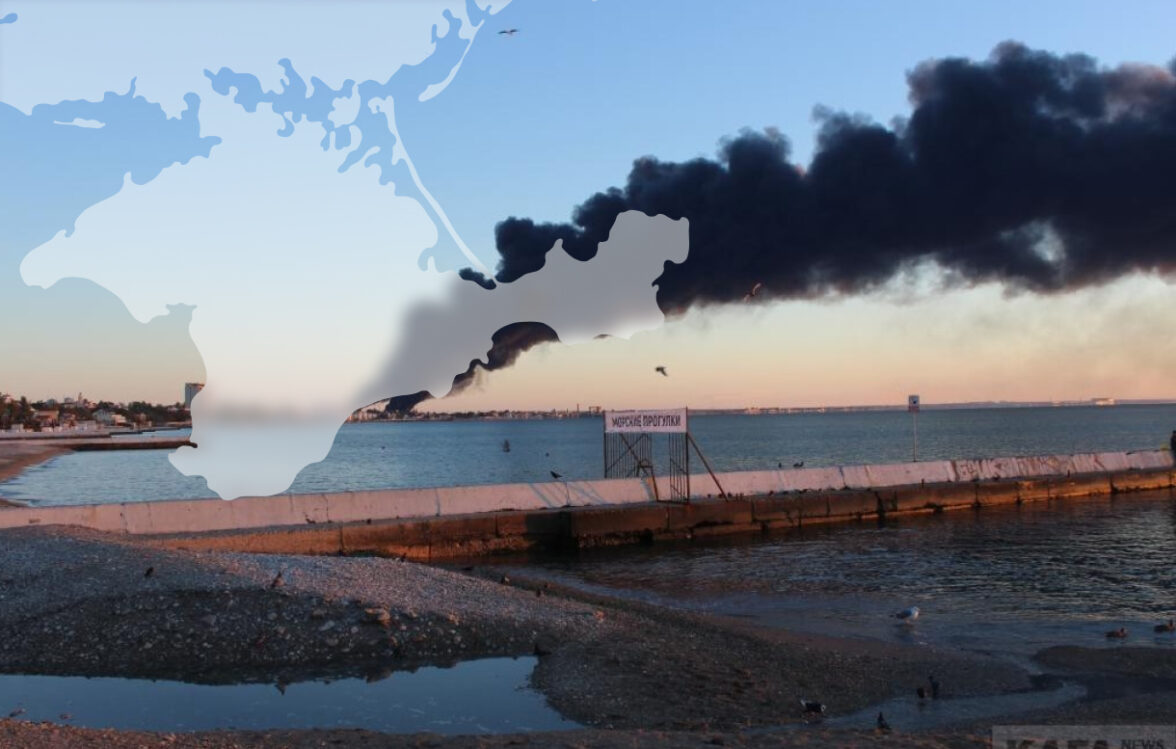
▶ During the night of November 11, Ukrainian Defense Forces units struck the Feodosia Sea Oil Terminal JSC, one of the key facilities used by Russian occupiers to supply fuel and lubricants by sea to the temporarily occupied Crimea and southern territories of Ukraine. According to preliminary reports, the strike hit fuel tanks on the terminal’s territory, causing a large-scale fire.
Crimes committed by the Russian Federation
▶ As of November 2025, Russia has unlawfully imprisoned 224 individuals in the occupied Crimea on ethnic, religious, and political grounds, including 133 Crimean Tatars.
▶ The wife of political prisoner Zaur Abdullaiev from Sevastopol reported that her husband’s health has sharply deteriorated and he is in urgent need of medical care. He suffers from diabetes and hypertension, as well as vision and dental problems. Medical assistance has been provided only partially — an ultrasound, cardiogram, and vision tests were conducted, but the results were not disclosed, except for a remark about an enlarged liver. His wife noted that his condition has been steadily worsening throughout his imprisonment, yet he still does not receive adequate treatment.
▶ In the village of Kyziltash, Yalta district, on October 2, resident Marat Batyrov was abducted from his own apartment, and for more than a month, there has been no information about his whereabouts. Witnesses saw unidentified men forcibly taking Batyrov out of his home, leading him to a garage, and then driving him away in an unknown direction. Representatives of the occupation “law enforcement” claimed that Batyrov is not being held in any detention facility in Crimea, but have provided no response to the lawyer’s inquiries regarding his fate. Marat Batyrov is a former Marine who retired at 45.
▶ In the temporarily occupied Crimea, Anna Sotsenko, a pensioner, and her daughter Oksana, who were abducted by Russian security forces earlier this year in the Pervomaiske district, have been transferred to Simferopol Pre-Trial Detention Center No. 1. Both women were held in complete isolation for an extended period and have now been charged with so-called “state treason.” Oksana Sotsenko’s ten-year-old son with a disability has been left without her care, while her 70-year-old mother suffers from several chronic illnesses. For nine months, there had been no information about their fate.
▶ Crimean political prisoner Raif Fevziiev, currently held in a penal colony in Yeniseisk, has severe health problems and limited access to medical care. He suffers from severe varicose veins and requires surgery, but is not receiving any treatment. He also has knee pain, dental issues, and has recently recovered from viral infections. The only medicines he receives are those sent by his family in parcels.
▶ Anatolii Kobzar, a resident of the temporarily occupied Sevastopol who had been missing for over a year and was later discovered in Simferopol Pre-Trial Detention Center No. 8, has been reduced to a state of dystrophy. During 20 months of unlawful detention, he has lost around 40 kilograms — now weighing only 62 kg at a height of 1.93 m, compared to nearly 100 kg before his arrest by the FSB. He was allowed his first visit with relatives only on October 31, during which “tears streamed continuously down his face,” and at age 45, he was already completely gray-haired. The meeting was permitted solely to pressure his relatives into testifying against him in a fabricated case, under the pretext of “family conflicts.” When asked about his condition, FSB representatives cynically claimed that he had “even gained a few kilograms” and was “looking perfectly fine.”
The use of occupied Crimea as a springboard for attacks on Ukraine and the militarization of the peninsula
▶ Activists of the “ATESH” resistance movement conducted reconnaissance at the artillery repair plant of the Russian Black Sea Fleet in the temporarily occupied Sevastopol, taking photo and video evidence of one of the key facilities servicing the occupiers’ warships in the Black Sea region. According to their reports, reconnaissance was carried out inside a workshop responsible for repairing and calibrating optical and optoelectronic devices for artillery systems — including sights, rangefinders, periscopes, laser target designators, optics for the “Bereg” and “Bastion-P” coastal missile systems, S-300 and “Pantsir” air defense systems, as well as night vision devices and thermal imagers for the marine infantry. Additionally, observation was conducted at pier No. 8, where Kalibr cruise missile carriers and small missile ships are based.
▶ Monitoring channels recorded the movement of a Pantsir-S1 surface-to-air missile and gun system along the Tavrida highway from Kerch toward Simferopol. According to observations, such equipment is typically redeployed from Russia into Crimea to replace destroyed or damaged units.
▶ According to the Air Forces of the Armed Forces of Ukraine, over the past week the Russian occupiers carried out a series of massive combined attacks across Ukraine, using 872 attack UAVs of the “Shahed,” “Shahed-Geran,” and “Gerbera” types, as well as three Kalibr cruise missiles, launched from the territory of occupied Crimea and the Black Sea. The Russian invaders continue to target Ukraine’s energy infrastructure ahead of winter, carrying out another wave of terror against the civilian population.
Since the beginning of Russia’s full-scale invasion and the expansion of its military aggression across the entire territory of Ukraine, the occupied Crimea has been used as a military base to project aggression in various forms. From the territory of the peninsula, the occupiers continue to launch strikes on Ukraine, including attacks on civilian infrastructure.
The resistance movement of Ukrainian citizens in occupied Crimea
▶ For showing solidarity with Ukraine, Russia has already persecuted 1,618 people in the occupied territory of Crimea, imposing illegal administrative penalties such as fines and arrests.
▶ A Crimean resident was detained for a social media comment written three years ago in support of Ukraine, in which he called the Russian occupiers “orcs.” The man was arrested over a comment dated January 2023, accused of so-called “discrediting the Russian army,” and fined 40,000 rubles.
▶ Activists from the “Yellow Ribbon” movement report that in temporarily occupied Crimea, the local occupation administration is forcing employees of public institutions to install the Russian messenger “Makh.” The activists also note that the occupation authorities have invented a new method of pressure on residents by coercing them into signing contracts with the Russian army. According to them, in Crimean villages people are being subjected to administrative and criminal cases for allegedly “unauthorized construction,” “violation of land use regulations,” and other similar offenses. It is emphasized that practically any construction can be deemed ‘illegal,’ allowing the occupiers to blackmail residents. Locals face fines of hundreds of thousands of rubles or property confiscation, which can only be “avoided” by signing a contract with the Russian armed forces.
▶ Activists of the “Crimean Combat Seagulls” continue to expose the personal data of collaborators and Russian war criminals in the occupied peninsula.
The full-scale invasion has marked a sharp increase in acts of solidarity and resistance among residents of occupied Crimea against the Russian occupiers. Locals unite into resistance movements such as “Yellow Ribbon,” “Crimean Combat Seagulls,” “ZLA Mavka,” “ATESH,” or act independently. To suppress this resistance after February 24, 2022, the occupation authorities have intensified persecution and administrative prosecution of Ukrainian citizens under the article on so-called “discrediting the Russian army.”
The de-occupation of Crimea is an essential part of ending the war and restoring peace. Ukrainians are doing everything possible to stop the aggressor and protect the entire world from Russia’s criminal actions. This is not a local or regional issue — Russia’s aggression poses a threat to the whole world and the international order.