16 September 2025
WEEKLY UPDATE ON THE SITUATION IN OCCUPIED CRIMEA ON SEPTEMBER 16, 2025
Main news of the week
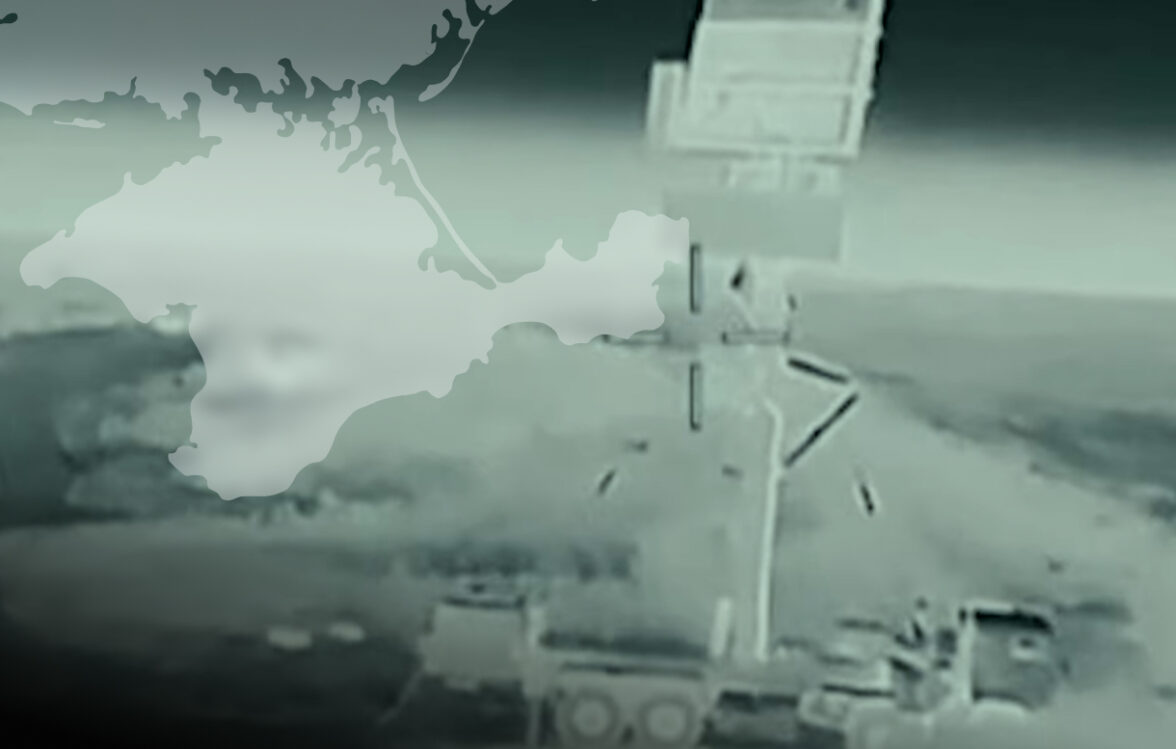
▶ The Defence Intelligence of Ukraine (DIU) carried out a series of precision strikes on two key Russian air defence facilities in temporarily occupied Crimea. A 48Ya6-K1 Podlyot radar station and an RLM-M radar module from the 55Zh6M Nebo-M system were destroyed. DIU special forces successfully hit the RLM-M module while it was on the move, as Russian troops were abandoning their position.
▶ On September 10, DIU special forces successfully attacked a Russian Black Sea Fleet vessel near Novorossiysk. At the time of the strike, the ship was conducting electronic reconnaissance near Novorossiysk Bay, where the remnants of Russia’s fleet are stationed. Ukrainian combat drones struck the ship’s command bridge, destroying reconnaissance equipment and disabling the vessel, which now requires costly repairs.
▶ On the night of September 11, the Ukrainian Navy struck the communications hub of Russia’s Black Sea Fleet at the 184th Research and Experimental Base in occupied Sevastopol. This hub had ensured command and control over Russian fleet units.
Crimes committed by the Russian Federation
▶ As of September 2025, Russia has illegally imprisoned 222 people in occupied Crimea on ethnic, religious, and political grounds, including 133 Crimean Tatars.
▶ Kremlin political prisoner Oksana Senedzhuk, illegally sentenced by the occupiers to 15 years, is being transferred to Women’s Colony No. 7 in Ulan-Ude, more than 6,000 kilometers from Crimea. Her daughter emphasized that among female political prisoners, her mother was the only one sent so far from home. Despite her request to remain closer to Crimea in order to care for her 87-year-old mother, the occupation authorities refused.
▶ An occupation “court” sentenced 60-year-old Viktor Ursu, a fourth-generation Jehovah’s Witness, to six years in prison on fabricated charges of organizing the activities of an “extremist organization.” In his final statement, Ursu stressed that he was neither a criminal nor an extremist, had lived in Dzhankoi for over 50 years, worked as a milling machine operator for 40 years at the same enterprise, and cared for his parents.
▶ Crimean Tatar political prisoner Enver Seitosmanov, illegally sentenced to 17 years, was placed in a punishment cell at Correctional Colony No. 16 in Salavat, Bashkortostan. The duration of his stay remains unknown. During his time in prison, Seitosmanov has been sent to solitary confinement over 30 times, often for observing Ramadan fasting or performing daily prayers.
▶ Crimean Tatar political prisoner Server Zekiriaiev, serving a 13-year sentence, has been held almost continuously in solitary-type facilities at Correctional Colony No. 1 in Donskoy, Tula region, for the past three years. According to his wife, he is kept in inhumane conditions, constantly rotated between solitary confinement and punishment cells, denied work, phone calls, and visits. He spent the entire summer in a solitary-type room and was immediately placed in a punishment cell for 12 days without explanation. Despite repeated appeals by his family to the prison administration, prosecutors, investigators, and courts, the pressure continues.
▶ Crimean Tatar political prisoner Rustem Emiruseinov, sentenced to 17 years, suffers from diabetes and related complications while serving his term in Colony No. 6 in Bezhetsk, Tver region. He has developed skin diseases exacerbated by diabetes, making even minor wounds inflamed and slow to heal. His health problems began earlier in Saratov region, where he lost 16 kg in two months, suffered severe itching in his legs, and experienced vision loss that prevented him from reading and writing. A prison hospital eventually diagnosed him with diabetes.
▶ Ukrainian citizen, Crimean political prisoner, and artist Bohdan Ziza was stripped of the Russian passport forcibly imposed on him, at his own request.
▶ Crimean Tatar political prisoner Ismet Ibrahimov was unlawfully transferred from Dimitrovgrad prison in Ulyanovsk region to Pre-Trial Detention Center No. 1 in Pskov. His final destination colony remains unknown.
▶ In occupied Feodosia, Russian security forces launched raids targeting so-called “illegal migrants” and locals not registered for military service. One raid was carried out at a construction site employing 12 people, including three Uzbek citizens, who faced additional harassment. Similar raids have been conducted in other occupied cities, at workplaces, residences, and temporary accommodations.
The use of occupied Crimea as a springboard for attacks on Ukraine and the militarization of the peninsula
▶ Activists of the resistance movement ATESH conducted reconnaissance at Military Unit 34685, the training center of Russia’s Black Sea Fleet near Lukomsky hamlet. Numerous antennas were identified: HF receiving systems, VHF/UHF antennas, satellite dishes, and broadband directional structures. According to agents, these facilities are used for communications, navigation, monitoring, and interception, while the center trains specialists for the fleet and plays a key role in its operations. Activists also scouted the 758th Logistics Center of the Black Sea Fleet in Sevastopol, finding almost no equipment, with a few vehicles inoperable — indicating shortages and efforts to hide assets across the peninsula from Ukrainian strikes.
▶ A monitoring group reported Russian air defence positions near occupied Kerch, including four S-300/S-400 launchers and two radar stations (30N6E2 and 96L6E). Coordinates have been confirmed, and surveillance of duty shifts and operational routines is ongoing.
▶ According to the Air Force of the Armed Forces of Ukraine, over the past week Russian occupiers have carried out a series of large-scale combined attacks on the territory of Ukraine — including 415 strike UAVs of the Shahed, Shahed-Heran, and Gerbera types, 42 cruise/air-launched missiles (Kh-101, Kalibr, Kh-59/69), launched in part from the territory of occupied Crimea and Black Sea.
Since Russia launched a full-scale invasion and spread its armed aggression throughout Ukraine, occupied Crimea has been used by Russia as a military base for spreading aggression in various forms. From the peninsula, the occupiers continue to launch attacks on the territory of Ukraine, including on civilian infrastructure.
The resistance movement of Ukrainian citizens in occupied Crimea
▶ Russia has already prosecuted 1554 people in occupied Crimea for expressing solidarity with Ukraine, who are being subjected to administrative penalties in the form of illegal fines and arrests.
▶ Activists of the Yellow Ribbon movement reported a cyber action that reached around 16,000 residents of occupied Sevastopol, informing them about the sham “governor elections.” Activists urged locals not to participate and spread posters across the city, stressing that no fake voting can change the truth: Crimea was, is, and will remain Ukraine. They also organized an action where residents submitted photos showing the real state of Sevastopol under occupation — destroyed landmarks, degraded nature, war, garbage dumps, and filth — contrasting with the occupiers’ propaganda promises of “development.”
▶ Activists of the Crimean Combat Seagulls continue to expose the personal data of collaborators and Russian war criminals in occupied Crimea.
▶ The Zla Mavka resistance movement declared that Ukraine remains present in occupied Crimea, with participants in Simferopol, Sevastopol, and Alushta displaying symbols of resistance. They emphasized that the occupiers’ so-called “elections” are mere theater with preordained results. They removed a tricolor flag from one polling station in Sevastopol and burned it, symbolizing their rejection of the occupiers’ sham.
The full-scale invasion was marked by a rapid increase in solidarity and resistance actions by residents of occupied Crimea against the Russian occupiers. Residents of occupied territories unite in resistance movements, such as the above-mentioned Yellow Ribbon, Crimean Combat Seagulls, Zla Mavka, and ATESH, or act individually. To suppress the resistance movement of residents in the temporarily occupied territory of Crimea after February 24, 2022, the occupiers actively began to prosecute and bring to administrative responsibility Ukrainian citizens under the article on the so-called “discrediting the Russian army.”
De-occupation of Crimea is integral to ending the war and restoring peace. Ukrainians are doing everything they can to stop the aggressor and protect the entire world from Russia’s criminal actions. This is not a local or regional issue but a threat to the world and international order.