02 September 2025
WEEKLY UPDATE ON THE SITUATION IN OCCUPIED CRIMEA ON SEPTEMBER 2, 2025
Main news of the week
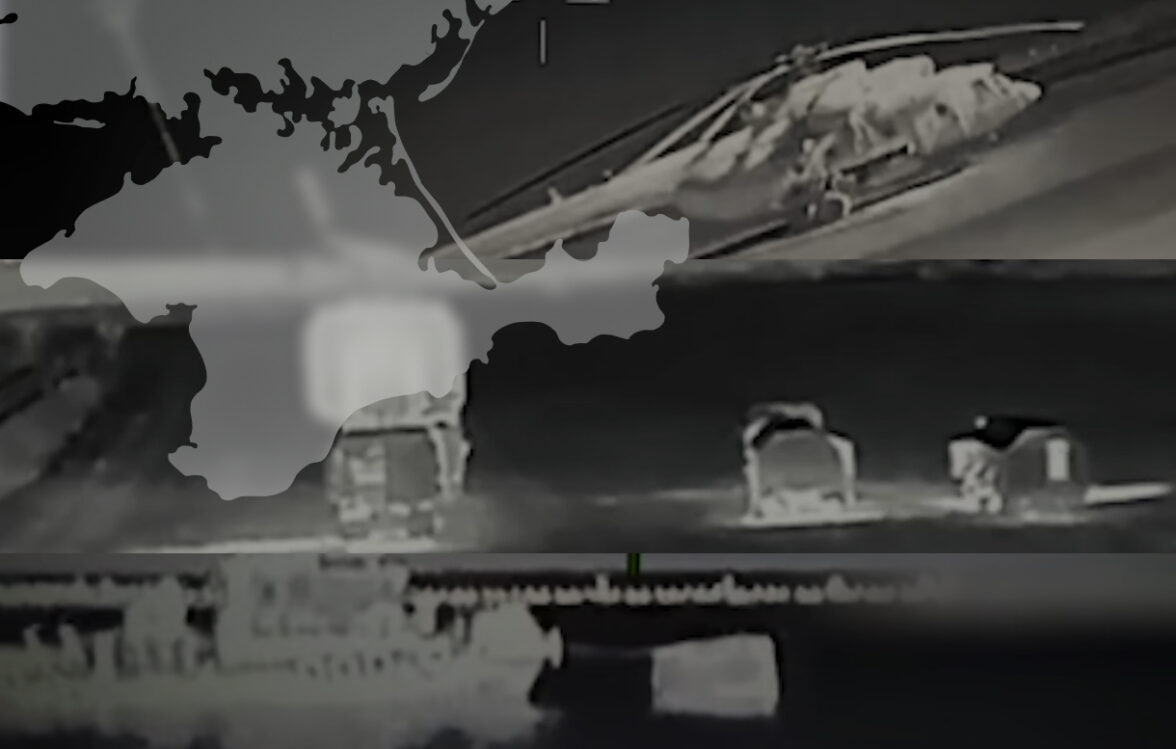
▶ On August 28, 2025, as a result of a joint operation by the Department of Active Measures of the Defence Intelligence of Ukraine (DIU) and the DIU special unit “Phantoms” in the Sea of Azov near temporarily occupied Crimea, a Russian Navy Project 21631 Buyan-M small missile ship — a carrier of Kalibr cruise missiles — was hit. Following the strikes, the Russian missile ship, which had been in a potential Kalibr launch zone in the Temryuk Bay, sustained damage and was forced to abandon its combat duty area. That same night, DIU special forces also destroyed an expensive Russian asset on the territory of occupied Crimea — a Russian 91N6E radar complex from the S-400 Triumf system.
▶ On the night of August 29–30, 2025, Ukrainian Special Operations Forces carried out a series of missions in occupied Crimea. As a result, a radar station of the S-300 complex located at the Russian military airfield in Saky was destroyed.
▶ On August 31, the Defence Intelligence of Ukraine reported new successful strikes on Russian targets in occupied Crimea. Among the destroyed high-value assets: the Utyos-T radar system; the RT-70 radio telescope; the GLONASS complex housed under a dome; the MR-10M1 Mys M1 radar; and the 96L6-AP radar belonging to the S-400 system. Ukrainian fighters also used drones to hit the Russian airbase in Hvardiiske near Simferopol, successfully destroying two enemy Mi-8 helicopters.
Crimes committed by the Russian Federation
▶ As of August 2025, Russia has illegally imprisoned 222 people in occupied Crimea on ethnic, religious, and political grounds, including 133 Crimean Tatars.
▶ Imam from Alushta, Lenur Khalilov, illegally sentenced by the Russian occupiers to 18 years in prison, has been released from the colony due to health reasons. He was diagnosed with cancer. Lenur Khalilov was detained in June 2019 along with other members of the “Alushta” community.
▶ Journalist and human rights defender Lutfie Zudiieva was summoned by the occupiers over an administrative protocol for allegedly “violating foreign agent legislation.” She now faces an unlawful fine of 30,000–50,000 rubles. The persecution stems from her publications about human rights violations in occupied Crimea, particularly regarding Crimean Tatar political prisoners, published in outlets such as Graty, CNN, Newsweek, and others, as well as interviews with international organizations.
▶ The lawyer of Crimean Tatar political prisoner Teimur Abdullaiev filed a lawsuit regarding his illegal confinement in a punishment cell at Penal Colony No. 2 in Salavat, Russia, where he has been held for more than 1,020 days. Abdullayev, arrested in 2020, has repeatedly been placed in solitary confinement under unlawful conditions. His health has significantly deteriorated, and his family reports that reasons for the punishments are not explained. Most recently, he was thrown into isolation for failing to greet the prison chief during prayer. In August 2025, three prison officials entered his cell and informed him of an “order” for his transfer to the high-security unit of Penal Colony No. 16, instructing him to stage a “violation.” He refused despite threats of unbearable conditions and violent transfer, which human rights defenders classify as torture.
▶ Crimean Tatar political prisoner Farkhod Bazarov was unlawfully placed in a high-security cell until December 9. Immediately upon arrival at Penal Colony No. 6 in Tver region, Russia, he was subjected to harsh confinement. Between July and September, he was twice sent to a punishment cell, including for “falling asleep on a bench” during the day — since prisoners are forbidden from daytime rest.
▶ 24-year-old Crimean Tatar woman Hatidje Buiukhchan, abducted by occupation forces in Staryi Krym on May 6, 2025, has been hit with new charges and had her detention extended. On July 9, she was accused of “high treason” under Article 275 of the Russian Criminal Code, and the so-called “court” extended her arrest until October 13, 2025. She is currently held in Pre-Trial Detention Center No. 1 in Simferopol, facing fabricated charges of “organizing terrorist activities” (Art. 30, Part 1, and Art. 205, Part 1 of the Russian Federation Criminal Code) and “illegal possession of explosives” (Art. 222.1, Part 3).
▶ Russian security forces in occupied Crimea detained a man born in 1972, accusing him of allegedly “organizing a banned religious group” for supposedly coordinating Jehovah’s Witness gatherings in Yalta and Alushta. The persecution of Ukrainian citizens on religious grounds continues.
▶ Crimean Tatar political prisoner Memet Belialov was unlawfully transferred to Penal Colony No. 9 in Petrozavodsk, Republic of Karelia. On July 11, he was removed from a colony in Novgorod region slated for closure, after which his family lost contact with him for a long time. Recently, his family received a letter stating he is being held under strict conditions in Petrozavodsk. Phone calls are banned, and his letters are not being delivered.
▶ 70-year-old Crimean Tatar Khalil Mambetov, unlawfully sentenced by Russian occupiers to 14 years in prison, was illegally transferred to Pre-Trial Detention Center No. 2 in Taganrog, Russia. He suffers from high blood pressure and requires medication.
▶ Political prisoner Ametkhan Abdulvapov remains in a punishment cell at Penal Colony No. 2 in Angarsk, Irkutsk region. The 36-year-old mechanical engineer from Simferopol was unjustly arrested in February 2022 and, in March 2023, sentenced to 10 years and 6 months in prison — the first three in prison, the rest in a strict-regime colony. Human rights defenders emphasize that his case is politically motivated and part of broader repression against Crimean Tatars.
The use of occupied Crimea as a springboard for attacks on Ukraine and the militarization of the peninsula
▶ Activists of the resistance movement ATESH report that Russian troops regularly arriving in occupied Dzhankoi are panicking after strikes on the city’s logistics infrastructure and are refusing deployment to the front. Trains and buses carrying new units arrive daily between 8:30–9:00. Morale among troops is described as “depressed.” Activists also reported nighttime explosions in several occupied cities — Yevpatoria, Yalta, Simferopol, and Sevastopol. Locals heard loud sounds resembling air defense activity. Near Novofedorivka airbase by Saky, fires and emergency vehicle movements were observed. Resistance representatives suggest this may be linked to strikes on Russian military infrastructure.
▶ According to the Air Force of the Armed Forces of Ukraine, over the past week Russian occupiers have carried out a series of large-scale combined attacks on the territory of Ukraine — including 1071 strike UAVs of the Shahed, Shahed-Heran, and Gerbera types launched in part from the territory of occupied Crimea and Black Sea.
Since Russia launched a full-scale invasion and spread its armed aggression throughout Ukraine, occupied Crimea has been used by Russia as a military base for spreading aggression in various forms. From the peninsula, the occupiers continue to launch attacks on the territory of Ukraine, including on civilian infrastructure.
The resistance movement of Ukrainian citizens in occupied Crimea
▶ Russia has already prosecuted 1536 people in occupied Crimea for expressing solidarity with Ukraine, who are being subjected to administrative penalties in the form of illegal fines and arrests.
▶ A so-called “court” sentenced a 45-year-old local resident to two years in a penal settlement colony, accusing him of posting alleged “calls to violence on ethnic grounds” on social media in 2022. In fact, he had left comments in Ukrainian chats supporting the Ukrainian Armed Forces, which occupiers classified as “russophobic.” He was also banned from administering websites for two years.
▶ Activists of the Yellow Ribbon movement continue their resistance in occupied Crimea. In Simferopol, Sevastopol, and Yalta, they placed Ukrainian ribbons, posters, and other symbols in public spaces. They also urged residents to boycott the so-called “elections” planned by the Russian occupation administration in September 2025, warning that any turnout would be used to legitimize illegal control over the peninsula. On August 29, Ukraine’s Day of Remembrance of Defenders, activists honored fallen soldiers and volunteers, stressing that Ukrainians in occupied cities remember each life given for independence.
▶ Activists of the Crimean Combat Seagulls continue to expose the personal data of collaborators and Russian war criminals in occupied Crimea.
▶ The Zla Mavka resistance movement reported a new action in occupied Sevastopol in solidarity with Kyiv residents after Russia’s massive missile strike on the capital on August 28. The city was decorated with quotes from Taras Shevchenko, Lesia Ukrainka, and Roman Shukhevych — words that for decades have inspired Ukrainians to fight for freedom and keep faith alive.
The full-scale invasion was marked by a rapid increase in solidarity and resistance actions by residents of occupied Crimea against the Russian occupiers. Residents of occupied territories unite in resistance movements, such as the above-mentioned Yellow Ribbon, Crimean Combat Seagulls, Zla Mavka, and ATESH, or act individually. To suppress the resistance movement of residents in the temporarily occupied territory of Crimea after February 24, 2022, the occupiers actively began to prosecute and bring to administrative responsibility Ukrainian citizens under the article on the so-called “discrediting the Russian army.”
De-occupation of Crimea is integral to ending the war and restoring peace. Ukrainians are doing everything they can to stop the aggressor and protect the entire world from Russia’s criminal actions. This is not a local or regional issue but a threat to the world and international order.