21 October 2025
WEEKLY UPDATE ON THE SITUATION IN OCCUPIED CRIMEA ON OCTOBER 21, 2025
Main news of the week
▶ On the morning of October 15, in temporarily occupied Crimea, Russian security forces conducted a series of illegal searches in the homes of Crimean Tatar women. In Bakhchysarai, Esma Nimetullayeva, a mother of many children and wife of political prisoner Remzi Nimetullayev, was detained. Searches also took place in the village of Kholmivka (at the home of Nasiba Saidova), in the village of Dolynne (at the home of Elviza Aliyeva), and in the village of Orlivka, Sevastopol District (at the residence of Fevziye Osmanova). All detainees were taken to Simferopol, to the so-called “FSB Directorate of the Russian Federation in the Republic of Crimea and the city of Sevastopol.”
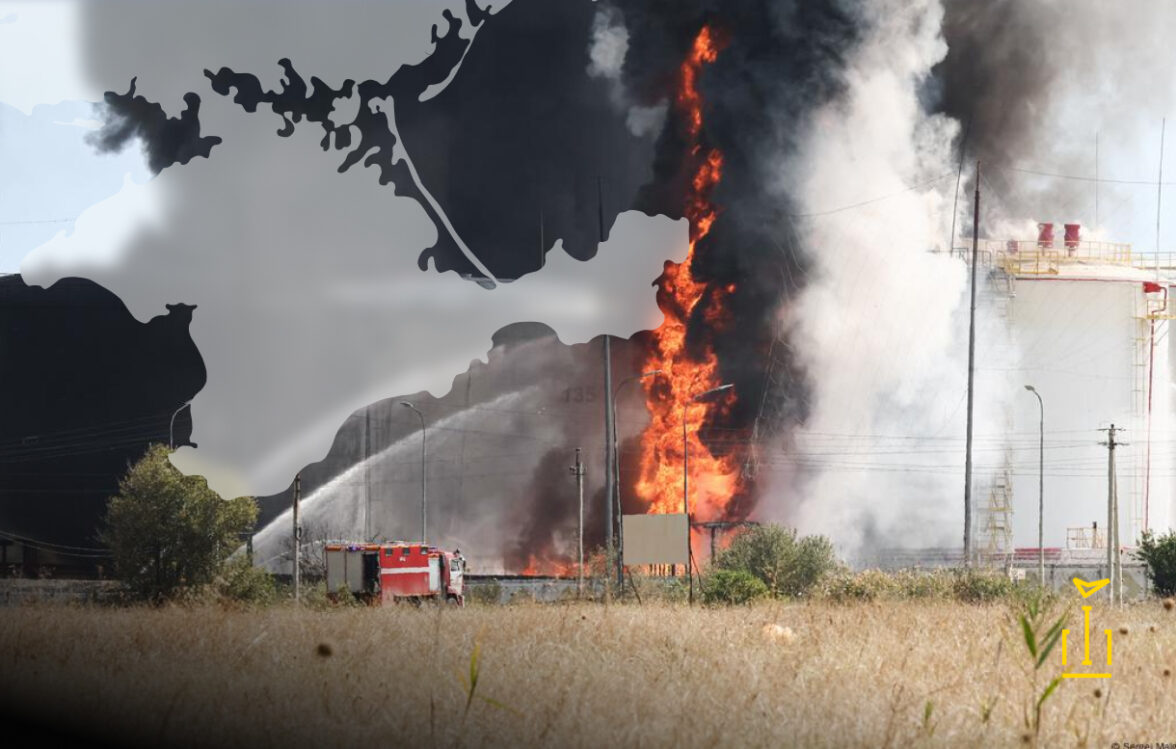
▶ On the night of October 17, the Armed Forces of Ukraine carried out a series of precise strikes on enemy military facilities and elements of fuel and energy infrastructure in temporarily occupied Crimea. As a result of the operation, an oil depot in the settlement of Hvardiyiske was hit, causing a fire after a hit on an RVS-2000 tank. In addition, facilities of the “Federal State Unitary Enterprise ‘Gvardiyskyi Plant’” in the village of Karierne, Saky District, a fuel and lubricant depot of Russian forces in Dzhankoi, and the Nebo-U radar station in Yevpatoria were destroyed.
Crimes committed by the Russian Federation
▶ As of October 2025, Russia has illegally imprisoned 222 people in occupied Crimea on ethnic, religious, and political grounds, 133 of whom are Crimean Tatars.
▶ Crimean Muslim Latifa (Nina) Malakhova was released after serving four and a half years of unlawful imprisonment by Russia in a women’s penal colony in the Krasnodar region. She currently resides in temporarily occupied Simferopol with her daughter but remains under administrative restrictions for another year — she is prohibited from leaving the city, being outside her home between 10:00 p.m. and 6:00 a.m., attending mass events, or changing her place of residence without permission from supervising authorities.
▶ The occupiers extended the illegal detention of six individuals in the so-called “Case of the Crimean Muslims”— Crimean Tatars Seydamet Mustafayev, Remzi Nimetullayev, Abdulmedzhit Seytumerov, Ruslan Asanov, Eldar Yakubov, and Ametkhan Umerov. They will remain in pre-trial detention at least until February 23, 2026, after which the “court” will again consider whether to extend the preventive measure. According to their lawyer, Emil Kurbedinov, the defense objected to the decision, highlighting inhumane conditions in Pre-Trial Detention Center No. 1 in Rostov-on-Don. He reported that the defendants are held in unsanitary rooms, among rats and insects, which has worsened their health and exacerbated chronic illnesses. Despite this, the “court” rejected all motions submitted by the defense.
▶ On October 9, 2025, the occupying “court” unlawfully extended the detention of 24-year-old Crimean Tatar Hatidje Buyukchan until December 13, 2025. She disappeared on May 6, 2025, after boarding a bus from Staryi Krym to Simferopol and ceased all contact. Only several days later did her family learn that she was being held by FSB officers in Simferopol. The lawyer contracted by her family was not allowed to meet with her.
▶ Lera Dzhemilova, a resident of Crimea illegally convicted of alleged “state treason” and held in Pre-Trial Detention Center No. 1 in Simferopol, requires urgent medical attention. Dzhemilova has been diagnosed with epilepsy, and under detention her seizures have become more frequent and severe. On September 5, a doctor was called, but the assistance provided was insufficient. Despite receiving anti-epileptic medication, her condition continues to deteriorate.
▶ Russian occupiers re-arrested political prisoner and “Case of the Crimean Muslims” defendant, 57-year-old Crimean Tatar Lenur Khalilov, who had been released from a Russian penal colony on health grounds. Khalilov has been diagnosed with multiple illnesses: primary liver cancer with metastases to lymph nodes, chronic hepatitis C, stage II hypertension, small liver cysts, a cyst in the left kidney, and kidney stones. The Russian court concluded that Khalilov cannot be imprisoned due to his malignant cancer.
▶ Political prisoner from Kherson, Iryna Horobtsova, who was illegally sentenced by the occupiers to 10.5 years on fabricated charges, was transferred for the second time to Colony No. 2 in Yavas, Republic of Mordovia.According to her father, Volodymyr Horobtsov, conditions in the colony are extremely harsh — imprisoned women work under exhausting conditions and strict regulations. Iryna’s health is deteriorating: she experiences frequent heart palpitations, headaches, and previously doctors identified a brain vessel aneurysm, posing a risk of stroke.
▶ 62-year-old Crimean Tatar political prisoner Azamat Eyupov, held in illegal Russian detention, suffered another hypertensive crisis. According to human rights defenders, during his time in detention he has already experienced four strokes.
The use of occupied Crimea as a springboard for attacks on Ukraine and the militarization of the peninsula
▶ Activists of the “ATESH” movement report the accelerated construction of a naval hospital in temporarily occupied Sevastopol. The reason for these actions is cited as significant losses suffered by occupying forces on the Kherson and Zaporizhzhia fronts. The resistance movement also reported reconnaissance of the launch positions of surface-to-air missile systems in temporarily occupied Sevastopol. Agents of the organization conducted surveillance of a strategic air defense facility that protects the Russian Black Sea Fleet and other military targets. The reconnaissance recorded the location of air defense systems, their operational activity, and military duty schedules. “ATESH” also carried out reconnaissance of the 127th Separate Reconnaissance Brigade of the occupying forces in Sevastopol. According to the movement, agents identified the locations of key brigade facilities (military unit 67606), duty schedules at posts, and movement routes of command personnel; the collected information was passed on to the Armed Forces of Ukraine.
▶ According to the Ukrainian Air Force, over the past week, Russian occupiers carried out a series of massive combined attacks across Ukrainian territory. These included 228 strike UAVs of types “Shahed,” “Shahed-Heran,” and “Gerbera”; 29 ballistic missiles of the “Iskander-M/KN-23” type; and 2 cruise missiles of the “Iskander-K” type, launched both from the temporarily occupied territory of Crimea and from the Black Sea.
Since Russia began its full-scale invasion and extended military aggression across Ukraine, occupied Crimea has been used by Russia as a military base to project aggression in various forms. From the peninsula, the occupiers continue to strike Ukrainian territory, including civilian infrastructure.
The resistance movement of Ukrainian citizens in occupied Crimea
▶ For showing solidarity with Ukraine, Russia is persecuting 1,602 people in occupied Crimea, subjecting them to administrative punishments in the form of unlawful fines and arrests.
▶ A resident of occupied Simferopol allegedly filmed the aftermath of drone attacks on Russian military facilities in Crimea. Russian occupiers quickly identified the man, held him administratively liable, drew up a protocol, and sent the case materials to the “court.”
▶ A Simferopol resident posted the Ukrainian song “Chervona Kalyna” on social media. Russian security forces detained the man, accused him of sharing allegedly “extremist content,” and sentenced him to five days of unlawful administrative arrest.
▶ A resident of Crimea posted a message on social media with the slogan “Glory to Ukraine” and expressed support for the Armed Forces of Ukraine. The occupiers illegally detained him, filed a protocol, and transferred the case materials to the “court.”
▶ A woman in Crimea posted messages condemning Russia’s war against Ukraine and included the slogan “Glory to Ukraine.” Security forces detained her, drew up a protocol, and sent the case to the “court.”
▶ Another woman in Crimea criticized Russia’s war against Ukraine on social media, supported the Armed Forces of Ukraine, and expressed support for the National Guard unit “Azov.” Russian forces detained her, filed a protocol, and forwarded the case to the “court.”
▶ A woman in Crimea posted messages in Ukrainian, opposed Russia’s war, and used the slogan “Glory to Ukraine.” Russian authorities detained her, drew up a protocol, and sent the case materials to the “court.”
▶ A resident of occupied Crimea posted an image of the sunken Russian cruiser Moskva, expressed support for the Armed Forces of Ukraine, and criticized Russia’s war. Russian security forces detained him, filed a protocol, and sent the case to the “court.”
▶ Activists of the “Yellow Ribbon” movement distributed yellow-blue ribbons, stickers, and other resistance symbols in occupied Simferopol, Sevastopol, and Yalta.
▶ Activists of the “Crimean Combat Seagulls” continue to expose personal data of collaborators and Russian war criminals in occupied Crimea. They reported that the so-called “Minister for Youth Affairs in Crimea” introduced new technical equipment to monitor social media, which poses a threat of even greater control and persecution of civilians by the Russian occupation regime.
▶ The “Zla Mavka” resistance movement carried out another action in occupied Sevastopol, Simferopol, and Alushta, reminding Russian occupiers that Crimea was, is, and will remain Ukrainian.
The full-scale invasion has led to a sharp increase in acts of solidarity and resistance by residents of occupied Crimea against Russian occupiers. Residents of the occupied territories unite in resistance movements, such as “Yellow Ribbon,” “Crimean Combat Seagulls,” “Zla Mavka,” and “ATESH,” or act individually. To suppress local resistance on temporarily occupied Crimea after February 24, 2022, occupiers actively persecute and hold Ukrainian citizens administratively liable under the article on so-called “discrediting the Russian army.”
The de-occupation of Crimea is an essential component of ending the war and restoring peace. Ukrainians are doing everything possible to stop the aggressor and protect the world from Russia’s criminal actions. This is not a local or regional problem; Russia’s aggression poses a threat to the entire world and the international order.