26 August 2025
WEEKLY UPDATE ON THE SITUATION IN OCCUPIED CRIMEA ON AUGUST 26, 2025
Main news of the week
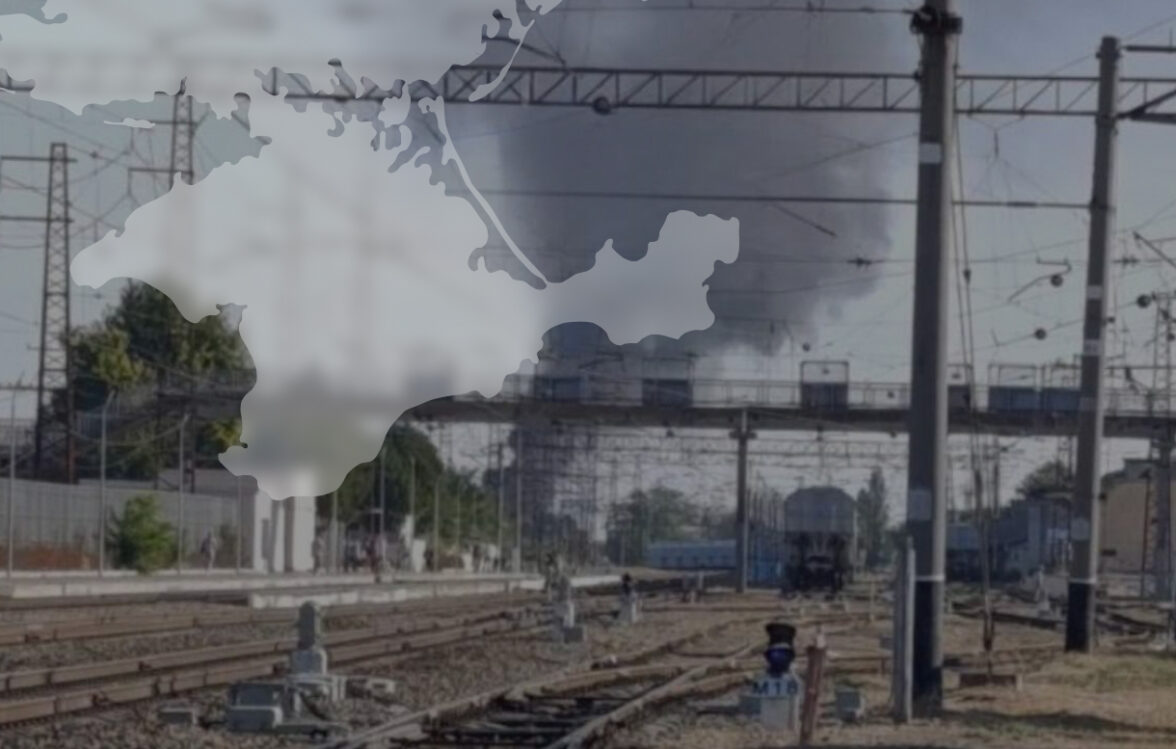
▶ The Ukrainian Special Operations Forces struck at the logistics of Russian occupiers in temporarily occupied Crimea. They managed to disable facilities that support the operation and combat supply of Russian military units. Eyewitnesses reported damage to the railway station in the village of Kurman. It is likely that an oil depot near the railway station in Dzhankoy was also hit.
Crimes committed by the Russian Federation
▶ As of August 2025, Russia has illegally imprisoned 222 people in occupied Crimea on ethnic, religious, and political grounds, including 133 Crimean Tatars.
▶ Imam from Alushta, Lenur Khalilov, illegally sentenced by the Russian occupiers to 18 years in prison, has been released from the colony due to health reasons. He was diagnosed with cancer. Lenur Khalilov was detained in June 2019 along with other members of the “Alushta” community.
▶ Crimean Tatar activist Medzhit Abdurahmanov, who was illegally sentenced to 12 years in prison, has been held for 11 months in the regime cells of Russian colony No. 9 in Tsivilsk (Chuvashia Republic). Since his arrival, Abdurahmanov has not spent a single day in the barracks — he is kept either in solitary confinement or in a small-type cell. Because of this, he has not been able to meet his family for two years; he is denied visits and phone calls, only allowed to correspond by letters. His health has deteriorated: spots have appeared on his face and body, his ulcer has worsened, his teeth are falling out, he suffers from headaches and high blood pressure, but he receives no medical care. Despite his family sending him medicines and vitamins, they were not provided to him in the colony.
▶ Crimean Tatar activist Akim Bekirov from Simferopol, sentenced by the Russian occupiers to 14 years in prison, has worsened health during his detention in correctional facility No. 9 in Chuvashia, Russia. He needs dental treatment, suffers from cervical osteochondrosis, and has skin problems, but he does not receive proper medical care.
▶ Political prisoner Teimur Abdullaiev has once again been placed in solitary confinement in Russian colony No. 2 in Salavat, with no explanation, and is threatened with transfer to a single small-type cell. Over the past five years, he has spent more than a thousand days in solitary confinement, deprived of the right to make calls or communicate with his family except through letters. His family reports a significant deterioration in his health due to the constant confinement in cold cells.
▶ Former political prisoner Vladyslav Yesypenko reported the critical health condition of Ukrainian political prisoner Halyna Dovhopola, who has been held in a colony in Vladimir region of Russia for over six years. She can barely move even with a cane, has a knocked-out tooth, looks emaciated, and is living in terrible conditions with minimal and poor-quality food.
The use of occupied Crimea as a springboard for attacks on Ukraine and the militarization of the peninsula
▶ Activists of the resistance movement ATESH reported on reconnaissance activities in the areas of the Kruhla and Hrafska bays in the occupied Sevastopol, which are key to Russian armed forces. It is noted that in Kruhla Bay, mobile groups with large-caliber machine guns are stationed in shifts to repel attacks from marine drones and down unmanned aerial vehicles. Agents of ATESH also reported on reconnaissance in the Kozacha Bay area in occupied Sevastopol, which is an important logistical hub for the Russian Black Sea Fleet. According to their data, an oil transshipment terminal used as a fuel base for the 810th separate marine brigade, a zone for amphibious assault ships, and a military dolphinarium of the Russian navy based on former military unit 13132-K are located there. They also discovered the decommissioned “Khersones” airfield, now used for launching drones, and the 561st emergency rescue center of the Special Operations Forces, an elite unit that trains naval commandos, divers, and rescuers. Its soldiers participated in the assault on Mariupol in 2022 and continue to fight today.
▶ Monitoring sources report that Russian military personnel are stationed with assault rifles on the beaches of occupied Sevastopol, and vehicles with anti-aircraft machine gun mounts are set up. Fire positions made of sandbags and wooden structures are also positioned along the beaches. Additionally, cargo trucks like Kamaz and Urals with anti-aircraft mounts are observed. The Russian Armed Forces are reportedly trying to cover the coastline from attacks by Ukrainian drones and marine drones.
▶ According to the Air Force of the Armed Forces of Ukraine, over the past week Russian occupiers have carried out a series of large-scale combined attacks on the territory of Ukraine — including 722 strike UAVs of the Shahed, Shahed-Heran, and Gerbera types, 2 Iskander-M ballistic missiles, 14 Kalibr cruise missiles, and 1 Zircon hypersonic missile, launched in part from the territory of occupied Crimea and Black Sea.
Since Russia launched a full-scale invasion and spread its armed aggression throughout Ukraine, occupied Crimea has been used by Russia as a military base for spreading aggression in various forms. From the peninsula, the occupiers continue to launch attacks on the territory of Ukraine, including on civilian infrastructure.
The resistance movement of Ukrainian citizens in occupied Crimea
▶ Russia has already prosecuted 1536 people in occupied Crimea for expressing solidarity with Ukraine, who are being subjected to administrative penalties in the form of illegal fines and arrests.
▶ A 62-year-old woman from Crimea, a postwoman from Feodosia, was sentenced to forced labor for one year and eight months for so-called “discrediting the Russian army.” The occupying “court” also imposed a two-year ban on her internet activity. The case allegedly stemmed from her posts on social media. She had previously been fined three times for posts in social media that allegedly “discredited the Russian Armed Forces.”
▶ Ahead of Ukraine’s State Flag Day, new murals appeared in temporarily occupied Crimea as part of the “Resistance Wall Paintings” project by the Special Operations Forces Resistance Movement and the National Resistance Center. On the southern coast of the peninsula, activists left patriotic images with the slogan “Crimea is Ukraine” and Resistance Movement symbols. These visual messages demonstrate the courage and resilience of people who, even under the pressure of occupiers, remind everyone that Ukraine lives in the heart of Crimea, and the fight for its liberation continues.
▶ Activists of the Yellow Ribbon movement decorated Simferopol, Sevastopol, Yalta, Feodosia, and Yevpatoria with pro-Ukrainian ribbons, stickers, and posters. Ahead of negotiations in Alaska, the movement activists also emphasized their belief in Ukraine’s return. Residents of Yevpatoria, Simferopol, and Sevastopol are waiting for the day when the blue and yellow flag will fly over their cities, as Crimea was and remains Ukrainian land. The activists also celebrated Ukraine’s State Flag Day and Independence Day in the temporarily occupied Crimea. On August 23, in Simferopol, they raised the Ukrainian flag in the Railway District, where after the 2014 occupation, the Ukrainian symbol was removed from the station. The following day, August 24, at dawn, activists unfurled the blue and yellow flag on Mount Kishka in Simeiz.
▶ Activists of the Crimean Combat Seagulls continue to expose the personal data of collaborators and Russian war criminals in occupied Crimea.
▶ The Zla Mavka resistance movement held an action on “Russian Flag Day” by setting fire to the occupiers’ tricolors in Kerch, Yevpatoria, Sevastopol, and Simferopol. The participants emphasized that in this way they demonstrate the true attitude of Crimea’s residents towards the occupiers’ symbolism, and every burned flag proves that Crimea is Ukraine.
The full-scale invasion was marked by a rapid increase in solidarity and resistance actions by residents of occupied Crimea against the Russian occupiers. Residents of occupied territories unite in resistance movements, such as the above-mentioned Yellow Ribbon, Crimean Combat Seagulls, Zla Mavka, and ATESH, or act individually. To suppress the resistance movement of residents in the temporarily occupied territory of Crimea after February 24, 2022, the occupiers actively began to prosecute and bring to administrative responsibility Ukrainian citizens under the article on the so-called “discrediting the Russian army.”
De-occupation of Crimea is integral to ending the war and restoring peace. Ukrainians are doing everything they can to stop the aggressor and protect the entire world from Russia’s criminal actions. This is not a local or regional issue but a threat to the world and international order.