27 January 2026
WEEKLY UPDATE ON THE SITUATION IN OCCUPIED CRIMEA ON JANUARY 27, 2026
Main news of the week
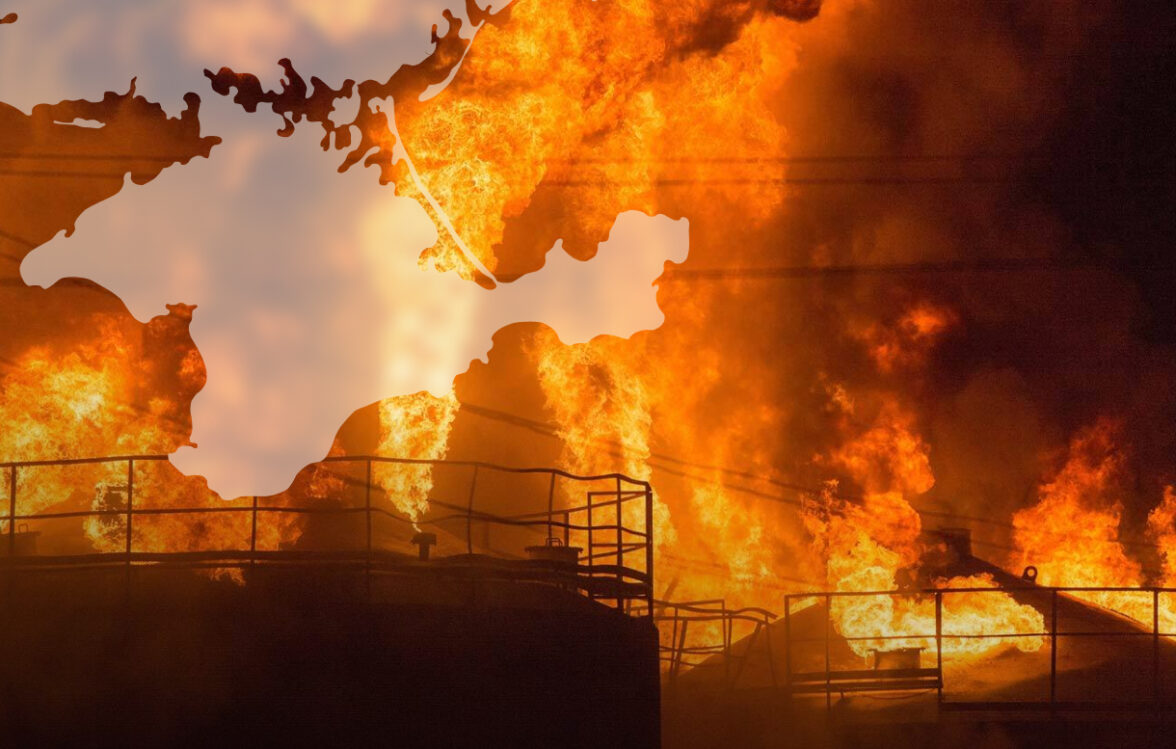
▶ The General Staff of the Armed Forces of Ukraine reported strikes on the Penzanefteprodukt oil depot in the Penza region of the Russian Federation, as well as on a radar station of the occupying forces in Crimea, specifically the 55Zh6 “Nebo-U” station.
▶ In the fourth quarter of 2025, the scale of political repression in temporarily occupied Crimea and Sevastopol reached an unprecedented level, exceeding the average Russian indicators by almost 4.9 times. Last year, this gap was about 2.8 times, indicating a zone of maximum repressive pressure. In particular, up to 88% of politically motivated criminal cases result in imprisonment, whereas in Russia itself, this figure stood at approximately 70% at the end of 2025.
▶ Activists of the ATESH movement report the systematic settlement of foreign migrants in residential buildings belonging to Ukrainian citizens in the temporarily occupied territories of the Kherson region and Crimea. In a number of occupied settlements, particularly in Melitopol, Yevpatoriia, and other cities, a massive arrival of foreigners, primarily from Cuba and India, is being recorded. They are recruited for low-paid jobs in the housing and communal services sector, promised Russian citizenship, and placed in so-called ownerless houses that remained empty after local residents were forced to leave.
Crimes committed by the Russian Federation
▶ As of 27 January 2026, in occupied Crimea, Russia has illegally imprisoned 224 individuals on ethnic, religious, and political grounds, 133 of whom are Crimean Tatars.
▶ The wife of political prisoner Tofik Abdulgaziiev reported a sharp deterioration in his health a month and a half after he was diagnosed with a malignant brain tumour. According to her, Abdulgaziiev complained of coordination disorders and serious difficulties with movement, and later reported increased dizziness and nosebleeds.
▶ The Russian “court” refused to consider the cassation appeal of the defence of the blind Crimean political prisoner Oleksandr Sizikov, sentenced to 17 years of imprisonment. The defence insisted that Sizikov has a Group I disability, has completely lost his sight, requires constant outside care, and that imprisonment threatens his life and contradicts the principle of humanity. However, the Russian “court” ruled that total blindness allegedly does not pose an immediate threat to the political prisoner’s life.
▶ The wife of Crimean political prisoner Tymur Yalkabov reported that her 45-year-old husband, sentenced to 17 years of imprisonment and transferred to Correctional Colony No. 17 in the Murmansk region, was diagnosed with hepatitis. In addition, Tymur Yalkabov has chronic asthma and a Group III disability; he was transferred to the colony in the Murmansk region in April 2025.
The use of occupied Crimea as a springboard for attacks on Ukraine and the militarization of the peninsula
▶ The monitoring group “Crimean Wind” discovered an enemy military facility in the area of the city of Sudak. The facility houses storage warehouses for military equipment of the 133rd Logistics Brigade of the Black Sea Fleet of the Russian Federation. This brigade provides supply and logistical support to the units of the 22nd Army Corps of the Russian Black Sea Fleet.
▶ According to the Air Force of the Armed Forces of Ukraine, over the past week, Russian occupiers carried out a series of massive combined attacks on the territory of Ukraine. In particular, more than 659 attack UAVs of the Shahed, Shahed-Geran, and Gerbera types, 3 Zircon anti-ship missiles, and 1 Iskander-M ballistic missile were launched, including from the territory of occupied Crimea and the waters of the Black Sea. Russian invaders continue to attack Ukraine’s energy infrastructure during the winter, carrying out yet another terror campaign against the civilian population.
Since Russia launched the full-scale invasion and extended military aggression to the entire territory of Ukraine, occupied Crimea has been used by Russia as a military base for spreading aggression in various forms. From the territory of the peninsula, the occupiers continue to launch strikes on the territory of Ukraine, particularly on civilian infrastructure.
The resistance movement of Ukrainian citizens in occupied Crimea
▶ For showing solidarity with Ukraine, Russia has already persecuted 1,672 people in the occupied territory of Crimea, imposing illegal administrative penalties such as fines and arrests.
▶ Activists of the Yellow Ribbon movement joined the action dedicated to the Day of Unity of Ukraine and once again reminded the world that the temporarily occupied territories are an inseparable part of our state.
The full-scale invasion has been marked by a sharp increase in acts of solidarity and resistance by residents of occupied Crimea against the Russian occupiers. Residents of the occupied territories unite in resistance movements such as the aforementioned “Yellow Ribbon,” “Crimean Combat Seagulls,” “Zla Mavka,” “ATESH,” or act individually.
To suppress the local resistance movement on the temporarily occupied territory of Crimea after 24 February 2022, the occupiers began actively persecuting and subjecting Ukrainian citizens to administrative liability under the article on so-called discrediting the Russian Armed Forces.
The de-occupation of Crimea is an essential part of ending the war and restoring peace. Ukrainians are doing everything possible to stop the aggressor and protect the entire world from Russia’s criminal actions. This is not a local or regional issue — Russia’s aggression poses a threat to the whole world and the international order.