28 October 2025
WEEKLY UPDATE ON THE SITUATION IN OCCUPIED CRIMEA ON OCTOBER 28, 2025
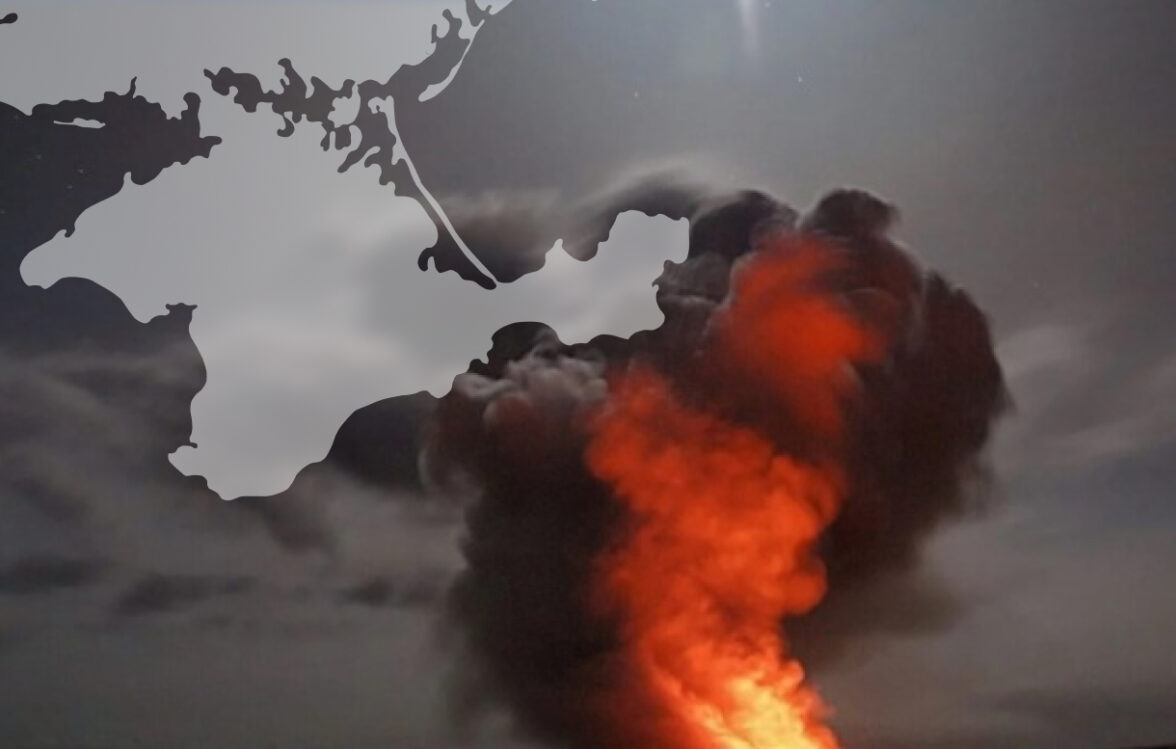
Main news of the week
▶ On 23 and 24 October 2025, special forces from the Active Operations Department of the Main Intelligence Directorate of the Ministry of Defense of Ukraine destroyed three modern air defense systems of the Russian occupying forces. Among the targets were a self-propelled launch vehicle of the Buk-M3 surface-to-air missile system and two 1L119 “Nebo-SVU” radar stations. According to the Main Intelligence Directorate, all the enemy’s air defense assets were eliminated in the temporarily occupied territories of Zaporizhzhia and Kherson regions, as well as in the Autonomous Republic of Crimea.
▶ On 26 October, the Main Intelligence Directorate of the Ministry of Defense of Ukraine reported that the special unit “Phantoms” struck three Russian radar stations and an assault boat in the temporarily occupied territory of Crimea. Specifically, the destroyed equipment included the 96L6 radar of the S-400 “Triumf” missile system, the P-18 “Terek” radar, the 55Zh6U “Nebo-U” radar, and a BK-16 type assault boat. The Main Intelligence Directorate emphasized that Ukrainian reconnaissance drones skillfully evaded enemy air defense missiles and continue to effectively destroy critical radar equipment of the occupiers on the peninsula.
Crimes committed by the Russian Federation
▶ As of October 2025, Russia has illegally imprisoned 222 individuals in occupied Crimea for ethnic, religious, and political reasons, including 133 Crimean Tatars.
▶ On the night of 23 October, employees of the so-called occupational “police” conducted a search at the home of Oleksandr Sizikov in the temporarily occupied Bakhchysarai district and re-arrested the man, who is completely blind. In May 2025, a Russian Minusinsk court in the Krasnoyarsk Territory released Sizikov from imprisonment due to his serious health condition. Later, the so-called “Bakhchysarai District Court” in temporarily occupied Crimea sentenced Sizikov to 10 days of administrative detention for allegedly “disobeying the police.”
▶ In mid-September, Russian occupiers in Crimea illegally arrested Leonid Pshenychnov, a leading Ukrainian scientist and Antarctic research specialist. He was accused of allegedly “creating a threat to the security of the Russian Federation” due to his participation in international scientific forums as a representative of Ukraine.
▶ Relatives of the female Crimean Tatar political prisoners reported on 15 October that they are being held in damp, unheated cells without hot water at Simferopol Detention Center No. 1. The cell conditions are extremely wet, and during brief outdoor walks, prisoners try to open windows to ventilate and reduce condensation, but the windows are loose and let in cold air. During inspections, detention center staff force women to remove their headscarves, which violates their religious beliefs.
▶ Former Kremlin political prisoner Vladyslav Yesypenko reported that Crimean detainee Ivan Yatskin, held in a Russian colony, needs medication and requests a walking stick. According to Yesypenko, Yatskin’s health remains serious — he suffers from a non-healing trophic ulcer on his leg and increasing difficulty in mobility. Despite this, the Russian administration has classified him as “prone to escape” and placed him under special monitoring. Yesypenko emphasized that Yatskin, despite his physical suffering, remains steadfast and faithful to his belief in Ukraine’s victory.
▶ On 17 October 2025, the occupational “court” issued a verdict in the case of Jehovah’s Witness Tamara Bratseva. She was illegally sentenced to 6 years and 3 months of probation for allegedly “organizing the activities of an extremist organization.” Bratseva stated in court that she has no connection to extremism and continues to practice her faith regardless of the existence of the Jehovah’s Witnesses organization. During the trial, her husband, with whom she had lived for 50 years, was involved in a traffic accident and hospitalized with a brain tumor, which was a severe blow for her. The stress caused her blood pressure to rise multiple times during hearings, requiring her to take medication in the courtroom.
▶ The health of Crimean Tatar political prisoner Amet Suleymanov, unlawfully sentenced to 12 years in a penal colony and held in the Vladimir Central Prison, continues to deteriorate. He has developed a matchbox-sized hematoma under his knee, likely related to heart problems and possibly indicating thrombosis or the consequences of a hypertensive crisis, which is the second such incident during his imprisonment. The prisoner also reports consistently high blood pressure, around 200 mm Hg, rising further in the evening.
The use of occupied Crimea as a springboard for attacks on Ukraine and the militarization of the peninsula
▶ Activists of the “ATESH” movement conducted a detailed reconnaissance of the 475th Separate Electronic Warfare Center of the Black Sea Fleet in temporarily occupied Sevastopol. They recorded the operational modes of the stations, frequency ranges, locations of antenna fields, personnel duty schedules, and movement routes of the command staff. It is noted that the center provides coverage for enemy ships, coastal complexes, and aviation, so its neutralization opens new opportunities for precise strikes against occupying forces.
▶ According to the Air Force of the Armed Forces of Ukraine, Russian occupiers carried out a series of massive combined attacks across Ukrainian territory over the past week. Specifically, 726 strike UAVs of the types “Shahed,” “Shahed-Herany,” and “Gerbera,” as well as 9 Iskander-K cruise missiles, were launched, including from the territory of occupied Crimea and from the waters of the Black Sea.
Since Russia launched its full-scale invasion and spread military aggression across the entire territory of Ukraine, occupied Crimea has been used by Russia as a military base to project aggression in various forms. From the peninsula, the occupiers continue to strike Ukrainian territory, including civilian infrastructure.
The resistance movement of Ukrainian citizens in occupied Crimea
▶ For demonstrating solidarity with Ukraine, Russia is now prosecuting 1,602 people in occupied Crimea, subjecting them to administrative penalties in the form of unlawful fines and detentions.
▶ In occupied Crimea, a local woman posted an image of the Ukrainian flag on social media. Occupation security officers detained the woman and referred the case to the so‑called occupation “court.”
▶ A 42‑year‑old resident of Crimea liked posts by a Ukrainian journalist on social media, posted messages opposing the Russian war, and referred to Russian servicemen as “orcs.” The occupiers detained the man, charged him with so‑called “discrediting the Armed Forces of the Russian Federation,” and fined him 40,000 rubles.
▶ A resident of occupied Sudak published social‑media posts critical of the Russian occupiers. The Russians detained the man and accused him of alleged “public calls for extremist activity.” He faces up to five years’ imprisonment.
▶ A man in Crimea publicly listened to Ukrainian songs. The occupation authorities construed this as “undermining trust in the Russian war against Ukraine” and as actions aimed at “discrediting the Armed Forces of the Russian Federation and partial mobilization.” The Russian occupiers detained the man and fined him 30,000 rubles.
▶ Activists of the “Yellow Ribbon” movement report that, at checkpoints in temporarily occupied Crimea, Russian servicemen have begun confiscating petrol from residents. According to their account, occupiers drain several liters of fuel from vehicles — a practice that emerged this week and is spreading daily. Drivers registered in Russia are not stopped, allegedly because “they are traveling far,” whereas owners of Ukrainian documents are routinely drained of fuel.
At the same time, activists held events in temporarily occupied Sevastopol, Yevpatoria, Simferopol, and Yalta on the occasion of Ukrainian Writing and Language Day. The event carried the symbolic name “Ї” — a letter that signifies native and intimate identity for every Ukrainian, recalling respect for one’s past and the right to determine one’s future. Participants stressed that the “Yellow Ribbon” movement will continue to resist until all Ukrainian territories are liberated.
▶ Activists of the “Crimean Combat Gulls” continue to expose personal data of collaborators and Russian war criminals in occupied Crimea.
▶ The resistance movement “Zla Mavka” continues to report on the realities of life under Russian occupation.
▶ Agents of the “ATESH” resistance movement reported a successful sabotage operation against Russian occupiers’ logistics in temporarily occupied Crimea. According to the movement, the operation targeted railway infrastructure in the Armyansk area; interference with relay equipment disrupted troop supply trains that were delivering materiel to Russian forces. “ATESH” stated that the strike coincided with a peak logistics period for the occupying forces, slowing the delivery of ammunition and materiel to units on the Kherson axis. The movement emphasized that it continues to systematically destroy the enemy’s logistical routes, expanding its agent network and increasing operational effectiveness.
Since the full‑scale invasion, there has been a sharp rise in acts of solidarity and resistance by residents of occupied Crimea against the Russian occupiers. Residents of the occupied territories are uniting in resistance movements — such as the aforementioned “Yellow Ribbon,” “Crimean Combat Gulls,” “Zla Mavka,” and “ATESH” — or acting individually. To suppress local resistance in the temporarily occupied territory of Crimea after 24 February 2022, the occupiers have actively persecuted and brought Ukrainian citizens to administrative liability under the article on so‑called “discrediting the Russian army.”
The de-occupation of Crimea is an integral part of ending the war and restoring peace. Ukrainians are doing everything possible to stop the aggressor and protect the entire world from Russia’s criminal actions. This is not a local or regional issue, as Russia’s aggression poses a threat to the whole world and to the international order.