29 April 2025
WEEKLY UPDATE ON THE SITUATION IN OCCUPIED CRIMEA ON APRIL 29, 2025
Main news of the week
▶ Political prisoner, journalist, and human rights defender Iryna Danylovych reported that the administration of the Russian penal colony where she is being unlawfully held is deliberately obstructing prisoners’ access to necessary medications. The medical unit lacks basic medicines, some drugs are diluted with water, and the distribution of others is deliberately delayed or blocked. Such actions constitute a form of psychological pressure on political prisoners and may qualify as cruel treatment and a war crime under Article 8 of the Rome Statute.
Crimes committed by the Russian Federation
▶ As of April 2025, Russia has illegally imprisoned 224 people in occupied Crimea on ethnic, religious, and political grounds, including 134 Crimean Tatars.
▶ 54-year-old Crimean Tatar Yashar Shykhametov, unlawfully sentenced to 11 years in prison, has been transferred to a prison hospital in Balashov, Saratov Region, Russia. He is suffering from back and kidney pain. In 2023, he had already reported serious health issues, but the Russian occupiers failed to provide him with the necessary medical care.
▶ A Russian “court” has unlawfully extended the detention of six Crimean Tatar activists from the so-called “Fifth Bakhchysarai Group” until August 23, 2025. According to lawyer Emil Kurbedinov, banned books may have been planted during searches by the occupiers, further evidencing the fabrication of charges. The defense team is preparing appropriate legal actions.
▶ Russia continues to use the Kerch Maritime Fishing Port as a tool for the illegal export of liquefied petroleum gas (LPG) and Ukrainian grain from occupied Crimea. The presence of LPG tankers — one of which has concealed identifiers — as well as a significant number of grain cars near the grain terminal has been recorded. Exports from this port have previously been directed to Middle Eastern countries, constituting a blatant violation of international law.
▶ Russians have extended the unlawful detention of political prisoner Andrii Kolomiets at the Center for Temporary Detention of Foreign Nationals for another 90 days — until mid-July. Andrii was arrested in 2015 in Kabardino-Balkaria, where he had traveled to visit his future wife. After being subjected to brutal torture, he was forced to confess to participating in the events of the Maidan. He was later transferred to occupied Crimea and sentenced on fabricated charges. In June 2016, an occupation “court” sentenced him to 10 years in a penal colony. On January 15, 2025, after serving his full sentence, Andrii was re-arrested and placed in the so-called “Center for Temporary Detention of Foreign Nationals.” Despite a formal decision for deportation, he has not been allowed to leave Russia. He has also been denied the opportunity to depart independently, which constitutes a further violation of his rights.
▶ Crimean political prisoner Volodymyr Yakymenko is being held by Russian occupiers in inhumane conditions without proper medical care. Despite suffering from serious stomach issues, he is not provided with a special diet, and medical assistance is effectively ignored. Since the beginning of 2025, he has spent 42 days in a punitive isolation cell, alternating between solitary confinement and harsh detention conditions. His health is rapidly deteriorating, with worsening chronic illnesses, dental problems, headaches, and emerging mental health disorders. In the colony, he is subjected to psychological pressure and provoked into conflicts.
The use of occupied Crimea as a springboard for attacks on Ukraine and the militarization of the peninsula
▶ Activists from the ATESH resistance movement reported that the occupiers in Crimea are preparing for mass population checks under the guise of anti-terrorist exercises scheduled for April 29. As part of these activities, the establishment of new checkpoints and increased patrolling are planned — including document inspections and searches of mobile phone contents. According to observations by agents, the so-called exercises also involve the covert relocation of equipment and air defense systems. The true aim of these raids is to identify pro-Ukrainian residents and individuals who may be cooperating with Ukraine’s Armed Forces.
▶ According to Ukraine’s Air Force Command, Russian occupiers carried out a series of attacks across Ukraine over the past week. These included 433 strike UAVs of the Shahed, Shahed-Geran, and Herbera types, 12 Kalibr cruise missiles, and 1 Iskander-M ballistic missile — launched in part from occupied Crimea and the Black Sea region. As a result of a combined Russian attack on Kyiv, at least 12 people were killed and more than 80 were injured.
Since Russia launched a full-scale invasion and spread its armed aggression throughout Ukraine, occupied Crimea has been used by Russia as a military base for spreading aggression in various forms. From the peninsula, the occupiers continue to launch attacks on the territory of Ukraine, including on civilian infrastructure.
The resistance movement of Ukrainian citizens in occupied Crimea
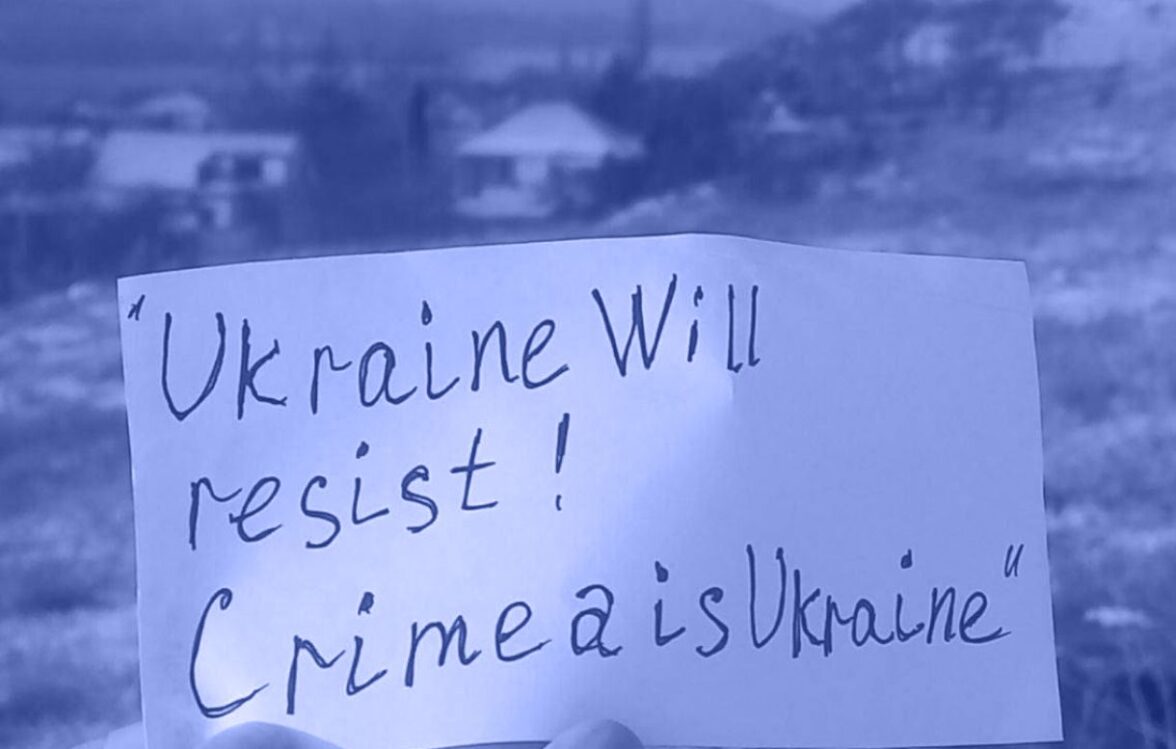
▶ Russia has already prosecuted 1325 people in occupied Crimea for expressing solidarity with Ukraine, who are being subjected to administrative penalties in the form of illegal fines and arrests.
▶ In occupied Crimea, a resident of Simferopol was criminally charged with “extremism” over a comment posted in a Ukrainian public group. Following her social media post, officers of the Russian Federal Security Service conducted a search of her home and opened a criminal case. Human rights defenders view such actions as examples of Russia’s repressive policies aimed at silencing residents who are disloyal to the occupiers.
▶ On the third anniversary of its activities, Yellow Ribbon resistance movement activists held another campaign. Patriotic symbols appeared on the streets of Sevastopol, Simferopol, Yevpatoriia, Kerch, Bakhchysarai, and Yalta, serving as a reminder that the resistance in Crimea continues until all Ukrainian territories are liberated within their internationally recognized borders.
▶ Activists from the Crimean Combat Seagulls continue to expose the personal data of collaborators and Russian war criminals in occupied Crimea.
▶ The Zla Mavka resistance movement continues to maintain its diaries, sharing insights into everyday realities under occupation. Activists carried out another campaign in Sevastopol, where, despite fear and strict control, lines from Ukrainian poets’ works are now appearing in public spaces. Youth and concerned citizens are adorning the streets with verses from Ukrainian literature.
The full-scale invasion was marked by a rapid increase in solidarity and resistance actions by residents of occupied Crimea against the Russian occupiers. Residents of occupied territories unite in resistance movements, such as the above-mentioned Yellow Ribbon, Crimean Combat Seagulls, Zla Mavka, and ATESH, or act individually. To suppress the resistance movement of residents in the temporarily occupied territory of Crimea after February 24, 2022, the occupiers actively began to prosecute and bring to administrative responsibility Ukrainian citizens under the article on the so-called “discrediting the Russian army.”
