29 October 2024
WEEKLY UPDATE ON THE SITUATION IN OCCUPIED CRIMEA ON OCTOBER 29, 2024
Main news of the week
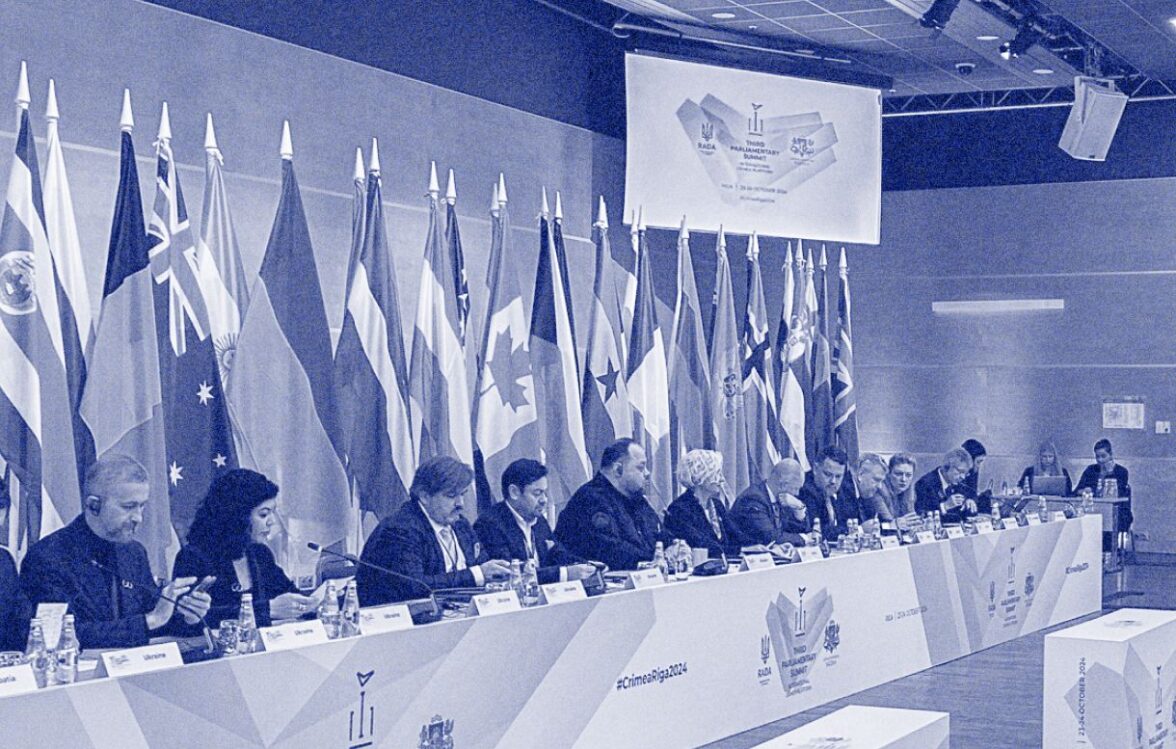
▶ On October 23–24, 2024, the Third Parliamentary Summit of the Crimea Platform was held in Riga, the capital of Latvia, gathering over 70 delegations, including 36 heads of parliament participating both online and offline. The summit concluded with a joint declaration from the participants of the Third Parliamentary Summit of the Crimea Platform, strongly condemning the Russian Federation’s aggressive actions against Ukraine. The participants reaffirmed their unwavering support for Ukraine’s sovereignty and territorial integrity, underscoring the necessity of de-occupying all captured territories, including Crimea.
Crimes committed by the Russian Federation
▶ As of October 2024, Russia has unlawfully imprisoned 218 people in occupied Crimea for ethnic, religious, and political reasons, including 132 Crimean Tatars.
▶ Rustem Seitkhalilov, a Crimean Tatar illegally sentenced by Russia, was unlawfully transferred to a Russian penal colony in the Republic of Kareliia, almost two thousand kilometers from Crimea. Upon arrival, the political prisoner was unjustly placed in solitary confinement for 14 days.
▶ The health of Rustem Sheikhaliiev, a civilian journalist from Crimea, is deteriorating in a Russian prison. He suffers from persistently high blood pressure and headaches, with occupiers denying him medical assistance.
▶ Russian security forces in occupied Crimea unlawfully arrested and detained 19-year-old Kazakh citizen Turan Ustiuhov for over two weeks. The occupiers, without evidence, accuse him of allegedly intending to join the Armed Forces of Ukraine.
▶ The occupation “court” dissolved the Muslim religious community “Alushta” following years of continuous pressure and attacks by Russian security forces. Russian occupiers continue systematic persecution of Crimean residents on religious grounds through illegal arrests of Muslims.
▶ The occupation “court” extended the illegal detention of Abdulmedzhyt Seitumerov, Remzi Nimetullaiev, Ruslan Asanov, Ametkhan Umerov, Seidamet Mustafaiev, and Eldar Yakubov from the so-called “fifth Bakhchysarai group” for another three months without providing new evidence. Russian occupiers unlawfully detain Crimean residents in an attempt to fabricate another criminal case against them.
▶ Remzi Bekirov, a Crimean civilian journalist illegally sentenced by Russia, has not contacted his family for nearly three weeks while unlawfully detained in a Russian penal colony. The last letter Bekirov sent his wife was on October 2, and he has not called his family in over two and a half months. Prison staff are withholding any information about him.
▶ The administration of the Russian occupation colony, along with Russian special services, is obstructing the parole process for Crimean journalist Vladyslav Yesypenko, whom a Russian “court” sentenced to five years in prison following torture. Yesypenko intended to file for parole, but Russian occupiers responded that they had no intention of releasing him.
▶ Emil Ziiadinov, a youth coach from Crimea unlawfully sentenced by Russia to 17 years in the “Crimean Muslims case,” was illegally transferred to a penal colony in the city of Koryazhma, Arkhangelsk region, over two and a half thousand kilometers from Crimea.
▶ Crimean political prisoner Asan Yanikov, held in a Russian prison by the occupiers, is denied permission to call or receive letters from his family. Furthermore, after being beaten by prison staff in April this year, his bread ration was reduced, causing a sharp weight loss that threatens his health. Russian occupiers use psychological pressure tactics on Crimean political prisoners through starvation, isolation from family, and harsh detention conditions.
The use of occupied Crimea as a springboard for attacks on Ukraine and the militarization of the peninsula
▶ According to Ukraine’s Air Force Command, Russian occupiers conducted a series of massive attacks on Ukrainian territory over the past week. These included 4 “Iskander-M/K” ballistic missiles, 2 Kh-22 cruise missiles, and 50 “Shahed” drones launched from occupied Crimea and the Black Sea. Russian invaders caused damage to civilian residential buildings across several regions in Ukraine.
▶ Resistance activists from the ATESH movement reported sightings of Russian military vessels in Streletskaya Bay, occupied Sevastopol. Activists documented three combat boats, the tug “SB-36,” and the rescue ship “Shakhtar” of the Russian Black Sea Fleet. All vessels are actively used by the occupiers for military purposes. The activists emphasize that the gathered information is highly valuable to the Ukrainian military and will be used to target the remaining occupational fleet.
Since Russia launched its full-scale invasion and expanded its military aggression across all Ukrainian territory, occupied Crimea has been used as a military base to project aggression in various forms. From the peninsula, the occupiers continue to launch strikes on Ukrainian territory, targeting civilian infrastructure in particular.
The resistance movement of Ukrainian citizens in occupied Crimea
▶ For showing solidarity with Ukraine, Russia is persecuting 979 individuals in occupied Crimea, imposing administrative penalties, including unlawful fines and arrests.
▶ A resident of occupied Crimea created a playlist of Ukrainian songs on social media. Russian security forces detained her, forwarding case materials to the occupation “court.”
▶ A woman from occupied Kerch expressed support for Ukraine on social media, accused Russia of aggressive actions against Ukraine, and criticized the activities of the occupation administration and army. She was detained by the occupiers, and the case materials were sent to the occupation “court.”
▶ A 26-year-old barber in occupied Crimea made negative comments about Russian military personnel. A case was opened against him in the occupation “court,” where he faces a fine ranging from 30,000 to 50,000 rubles.
▶ A resident of occupied Sevastopol criticized Russian military aggression and expressed support for the Ukrainian Armed Forces at his workplace. Russian security forces detained him, and case materials were sent to the occupation “court.”
▶ Activists from Yellow Ribbon conducted another action, demonstrating that the people of Crimea continue to resist Russian occupiers. Actions were held in Simferopol, Sevastopol, Yalta, and Novoozerne. Despite all threats, those living under occupation show that the spirit of freedom in Crimea remains alive, and resistance to Russian occupiers persists.
▶ Activists from the Crimean Combat Seagulls movement continue to expose the personal information of collaborators and Russian war criminals operating in occupied Crimea.
▶ The Zla Mavka resistance movement continues to document the realities of life in occupied territories in their journals. Additionally, activists distributed patriotic stickers along the Alushta coastline, reminding residents that Crimea remains a part of Ukraine.
The full-scale invasion was marked by a rapid increase in solidarity and resistance actions by residents of occupied Crimea against the Russian occupiers. Residents of occupied territories unite in resistance movements, such as the above-mentioned Yellow Ribbon, Crimean Combat Seagulls, Zla Mavka, and ATESH, or act individually. To suppress the resistance movement of residents in the temporarily occupied territory of Crimea after February 24, 2022, the occupiers actively began to prosecute and bring to administrative responsibility Ukrainian citizens under the article on the so-called “discrediting the Russian army”.
De-occupation of Crimea is integral to ending the war and restoring peace. Ukrainians are doing everything they can to stop the aggressor and protect the entire world from Russia’s criminal actions. This is not a local or regional issue but a threat to the world and international order.