04 November 2025
WEEKLY UPDATE ON THE SITUATION IN OCCUPIED CRIMEA ON NOVEMBER 4, 2025
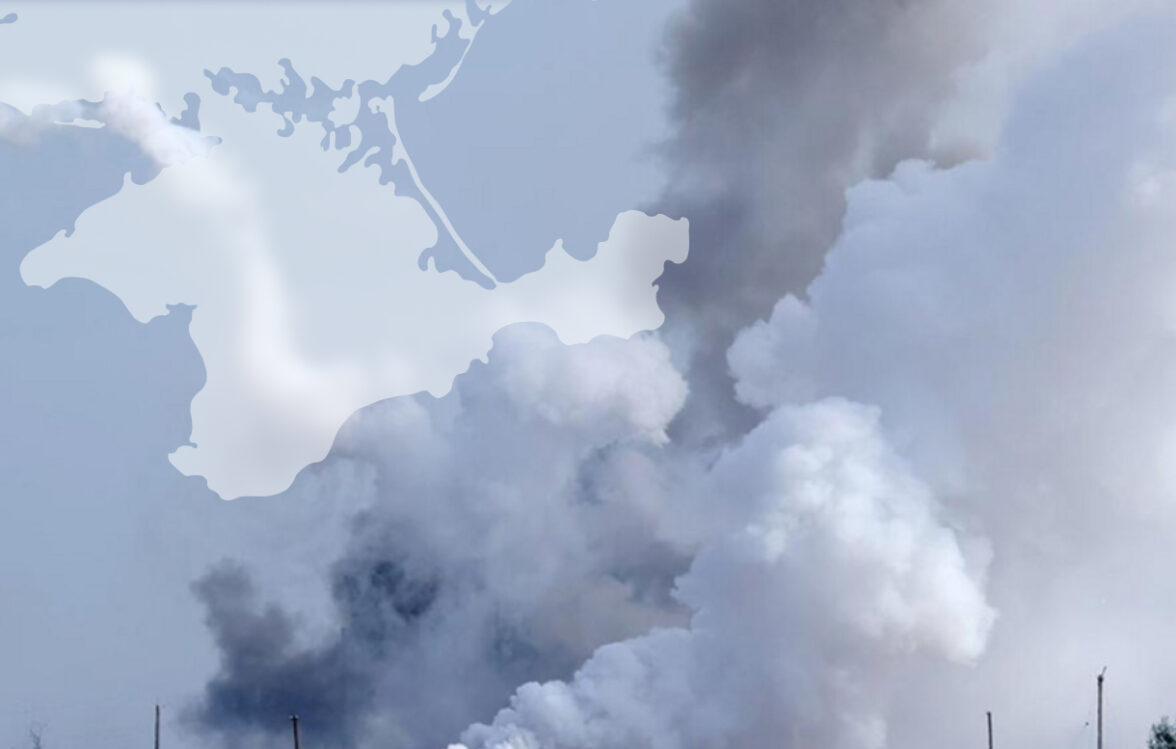
Main news of the week
▶ The Security Service of Ukraine (SSU), using strike drones, targeted a Pantsir-S2 air defense system, two oil depots, and two radar stations in the temporarily occupied territory of Crimea. According to reports, Russian forces lost the Pantsir-S2 system, valued at approximately USD 20 million, along with two radar stations, significantly weakening their air defense capabilities in the Crimean sector. Separately, special operations drones of the SSU’s “A” Center struck an oil depot in the settlement of Hvardiiske, where fuel supplies were stored, causing a large-scale fire with thick black smoke. Another strike was recorded on the Komsomolska oil depot.
▶ During the night of 1–2 November 2025, units of the Department of Active Operations of the Main Directorate of Intelligence of the Ministry of Defence of Ukraine (HUR MO) successfully destroyed several components of Russian air defense systems in the temporarily occupied territory of Crimea. As a result of a strike on the command post of an S-400 “Triumf” air defense battalion, a 92N6E multifunctional radar and autonomous power supply equipment of the system were destroyed. Additionally, intelligence units struck an AORL-1AS airfield surveillance radar and a P-18 “Terek” radar belonging to Russian occupation forces.
Crimes committed by the Russian Federation
▶ As of November 2025, Russia has illegally imprisoned 224 people in the occupied Crimea on ethnic, religious, and political grounds, including 133 Crimean Tatars.
▶ The health condition of 75-year-old Crimean political prisoner Volodymyr Ananiev is rapidly deteriorating at the place of his unlawful detention. He is held in Pre-Trial Detention Center No. 5 in Rostov-on-Don and is denied adequate medical care, particularly for problems with his eyesight, spine, muscles, and kidneys. Ananiev is at high risk: he has serious leg issues, moves with a cane, has undergone two eye surgeries, and suffers from glaucoma and high blood pressure.
▶ Four Crimean Tatar women — Esma Nimetulaieva, Elviza Alieva, Fevziye Osmanova and Nasiba Saidova —were forcibly placed in the Crimean Republican Psychiatric Hospital No. 1 named after N. I. Balaban to undergo a so-called “forensic psychiatric examination.” Meanwhile, the mothers of the detained women were not allowed to deliver food or personal items to their daughters under arrest. Later, the occupation “court” dismissed the lawyers’ appeals and kept the women in custody. The “court hearings” were held without their participation.
▶ In the occupied Crimea, the fate of Sakha Mangubi has remained unknown for a year since she was abducted by Russian security forces on 2 November 2024 following an anonymous report. Masked men conducted a search of her home without explanation and took her away, after which contact with her was lost. Sakha’s mother appealed to the police, the FSB, the prosecutor’s office, and the ombudsman but received only formal replies or assurances that “no such person is listed.” Unofficially, the family was told that several anonymous complaints had been filed against her. According to a former detainee, Sakha may be held in Pre-Trial Detention Center No. 2 in Simferopol, but there is no official confirmation. The family demands that her case be brought into the legal framework to ensure protection for the missing woman.
▶ The so-called “Supreme Court of the Republic of Crimea” annulled the decision on the administrative arrest of blind Muslim Oleksandr Sizikov and ordered his release on health grounds. However, according to his lawyer Emil Kurbedinov, the ruling has not been enforced — Sizikov’s whereabouts remain unknown. The lawyer stated that after receiving a copy of the decision, he went to the temporary detention center in Bakhchysarai, but his client was not there. He was told that Sizikov had allegedly been transferred to Simferopol, yet he could not be found either in the temporary detention center or in the special reception center for administrative detainees. Kurbedinov stressed that Sizikov has been illegally held in custody for nine days, and he has been unable to secure the enforcement of the court decision that entered into force on 31 October.
The use of occupied Crimea as a springboard for attacks on Ukraine and the militarization of the peninsula
▶ Activists of the “ATESH” movement reported that Russian occupiers in the temporarily occupied Sevastopol are massively dismantling decommissioned vehicles to compensate for equipment losses. The movement emphasizes that this indicates an acute shortage of spare parts among Russian troops in the southern sector. ATESH agents are also conducting reconnaissance of a special forces unit of the Russian Black Sea Fleet in temporarily occupied Sevastopol, which is involved in guarding the Crimean Bridge. According to them, they managed to survey the territory of the 102nd Separate Special-Purpose Detachment for Countering Underwater Sabotage Forces and Means of the Russian Federation in the Konstantinovska Bay. They identified the locations of piers, an observation post, boats, and equipment inside the facility. ATESH noted that striking this military base would weaken the protection of the Kerch Bridge and reduce the presence of occupation forces in Crimea.
▶ According to the Air Force Command of the Armed Forces of Ukraine, Russian occupiers have carried out a series of massive combined attacks on Ukrainian territory over the past week. The assaults involved 1,151 Shahed, Shahed-Geran, and Gerbera attack UAVs; eight Kalibr cruise missiles; four Iskander-M ballistic missiles; two Kh-59/69 guided air-to-ground missiles; and one Kh-31P guided missile, launched in part from the occupied territory of Crimea and the Black Sea region. Russian invaders continue to target Ukraine’s energy infrastructure ahead of winter, carrying out yet another campaign of terror against the civilian population.
Since the beginning of Russia’s full-scale invasion and its expansion of military aggression across the entire territory of Ukraine, the occupied Crimea has been used by Russia as a military base for projecting aggression in various forms. From the territory of the peninsula, the occupiers continue to launch strikes on Ukraine, including against civilian infrastructure.
The resistance movement of Ukrainian citizens in occupied Crimea
▶ For showing solidarity with Ukraine, Russia has persecuted 1,618 people in the temporarily occupied territory of Crimea. These individuals have faced administrative penalties in the form of unlawful fines and arrests.
▶ A resident of temporarily occupied Yevpatoria was detained by the occupation authorities for publicly using the slogan “Glory to Ukraine” at a party a year and a half ago. He was illegally placed in a pre-trial detention cell, and his case has been submitted to the occupation “court.”
▶ Activists of the “Yellow Ribbon” movement reported that they continue to expand the resistance network in the temporarily occupied Simferopol, Sevastopol, and Yalta. According to them, more and more yellow ribbons and stickers — symbols of Ukrainian resistance — are appearing in public places across these cities. New resistance marks have been spotted in busy areas, reminding the occupiers that their time is running out, and the residents of Crimea that they are not alone and de-occupation is inevitable.
▶ Activists of the “Crimean Battle Seagulls” movement continue to expose the personal data of collaborators and Russian war criminals operating in occupied Crimea.
▶ The “Zla Mavka” resistance movement reported ongoing resistance actions in temporarily occupied Simferopol and Sevastopol. They published new photos from locations where symbols of defiance appeared, noting that they are “ready for Halloween everywhere” and that their festive pumpkins are “special”— a hint at their hidden protest meaning.
The full-scale invasion has been marked by a sharp rise in acts of solidarity and resistance by residents of occupied Crimea against the Russian occupiers. Locals have united into organized resistance movements such as “Yellow Ribbon,” “Crimean Battle Seagulls,” “Zla Mavka,” and “ATESH,” or act individually.
In an attempt to suppress this resistance, since February 24, 2022, the occupying authorities have intensified persecution and administrative prosecutions of Ukrainian citizens under the article on so-called “discrediting the Russian army.” The de-occupation of Crimea is an integral part of ending the war and restoring peace. Ukrainians are doing everything possible to stop the aggressor and protect the entire world from Russia’s criminal actions. This is not a local or regional issue — Russia’s aggression poses a threat to global security and the international order.