24 November 2025
During the Fourth Parliamentary Summit of the Crimea Platform, delegations from Poland, Slovakia, Slovenia, Spain and the United Kingdom provided statements
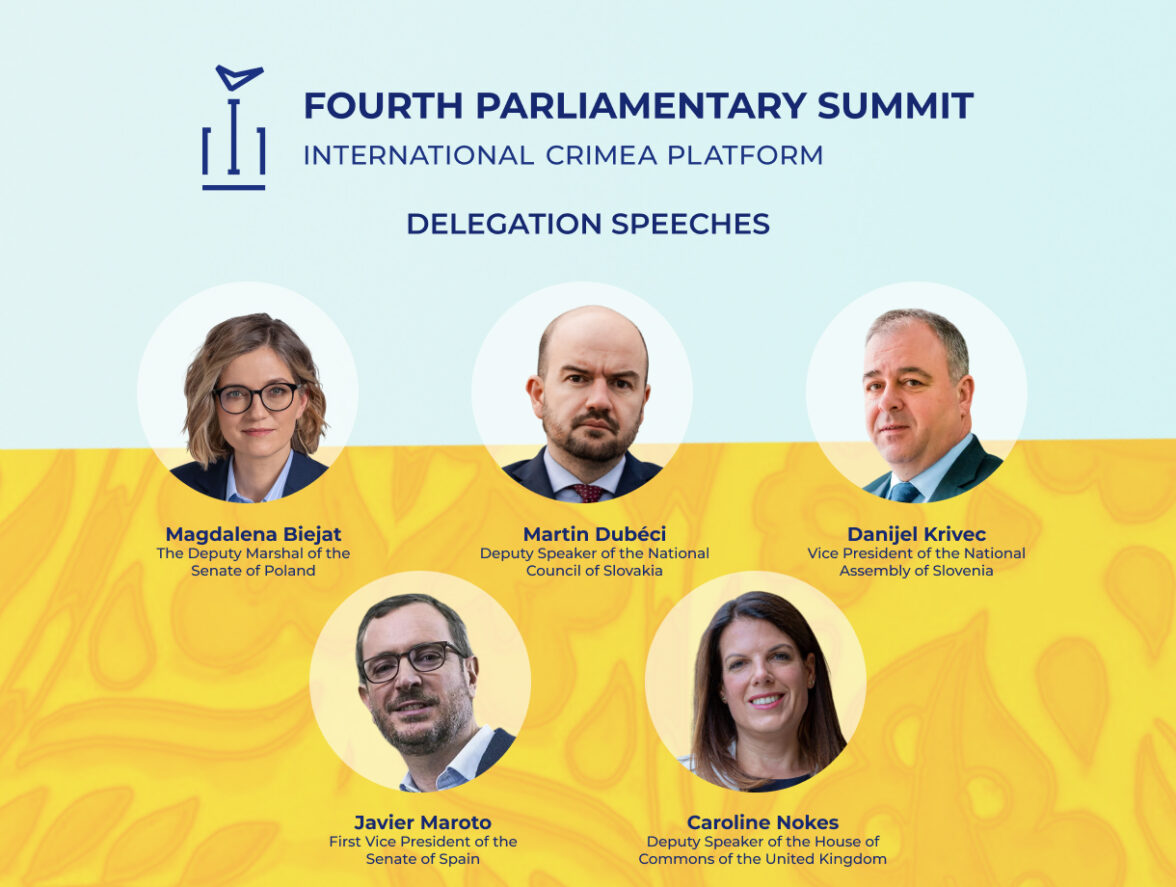
“Russia is waging war not only on the territory of Ukraine but also inside cyberspace. Physical distance from the frontline is no longer relevant because every smartphone has become a battlefield, and the stakes are nothing less than the defense of our democratic system,” highlighted Magdalena Biejat, The Deputy Marshal of the Senate of Poland.
Biejat emphasized the urgent need for international unity against Russia’s aggression, stressing the importance of imposing stronger sanctions, particularly targeting Russia’s oil and financial sectors. She also highlighted the humanitarian crisis in Crimea and condemned Russia’s attempts to erase Crimean identity, especially the rights of the Crimean Tatars. In addition, she affirmed Poland’s support for peace efforts, but underlined that Ukraine’s perspective must be central to any peace plan for it to ensure long-lasting justice.
“The Slovakian government recognizes that the peaceful, independent, democratic, and prosperous Ukraine is in our national interest. It welcomes initiatives towards a comprehensive, just, and lasting peace,” stated Martin Dubéci, Deputy Speaker of the National Council of Slovakia.
Dubéci also reaffirmed Slovakia’s commitment to Ukraine’s sovereignty and territorial integrity, stressing that his country never recognized the occupation of Crimea. He underlined Slovakia’s support for a just and lasting peace and continued to provide humanitarian and military aid to Ukraine. Moreover, Slovakia stands firm in its support for Ukraine’s future European Union membership and remains dedicated to assisting in recovery and reconstruction efforts.
“Only Ukraine can decide the terms of the future peace agreement, and it must include firm and credible guarantees for Ukraine, so history does not continue to repeat itself,” highlighted Danijel Krivec, Vice President of the National Assembly of Slovenia.
Krivec emphasized the critical need for continued political, humanitarian, and military support for Ukraine, especially with the harsh winter approaching. He also highlighted the importance of securing the release of Ukrainian political prisoners and civilians, particularly those from Crimea. Krivec reiterated Slovenia’s commitment to supporting Ukraine’s peace efforts and affirmed that Ukraine’s future must include firm guarantees to prevent further aggression. Additionally, he expressed hope that Ukraine would soon become a member of the European Union.
“What kind of peace are we trying to build? This is not a negotiation between equals; it is a country under attack, being asked to sign under extreme duress with the clock ticking down,” stated Javier Maroto, First Vice President of the Senate of Spain.
Maroto emphasized the urgency of Ukraine’s situation, highlighting the disproportionate pressure Ukraine faces in the negotiation process. He criticized the expectation for Ukraine to accept all terms upfront, without any tangible concessions from Russia. Maroto reaffirmed Spain’s commitment to Ukraine’s sovereignty and territorial integrity, underscoring that Spain and the European Union would continue to support Ukraine’s European path and stand firm on defending its borders. He also called for explicit guarantees to prevent unjust peace terms from compromising Ukraine’s future security.
“The United Kingdom strongly supports the Crimea Platform and its determination to raise global ambition and engagement on Crimea and ensure that Russia continues to be held accountable for its aggression,” stated Caroline Nokes, Deputy Speaker of the House of Commons of the United Kingdom.
Nokes condemned the ongoing human rights abuses in the region, particularly the deportation, indoctrination, and militarization of children, which she strongly condemned. Nokes also highlighted the UK’s firm stance on Ukraine’s sovereignty, stressing that the UK would continue to support Ukraine in its fight against Russian aggression and work to ensure that international borders remain unaltered by force. Furthermore, she underlined the UK’s dedication to securing the return of Ukrainian children abducted by Russia. She also reiterated that the fight for Ukraine’s territorial integrity is a cause that should unite all nations.