24 November 2025
At the fourth Parliamentary Summit of the Crimea Platform, representatives of delegations from Australia, Liechtenstein, and Switzerland delivered their statements
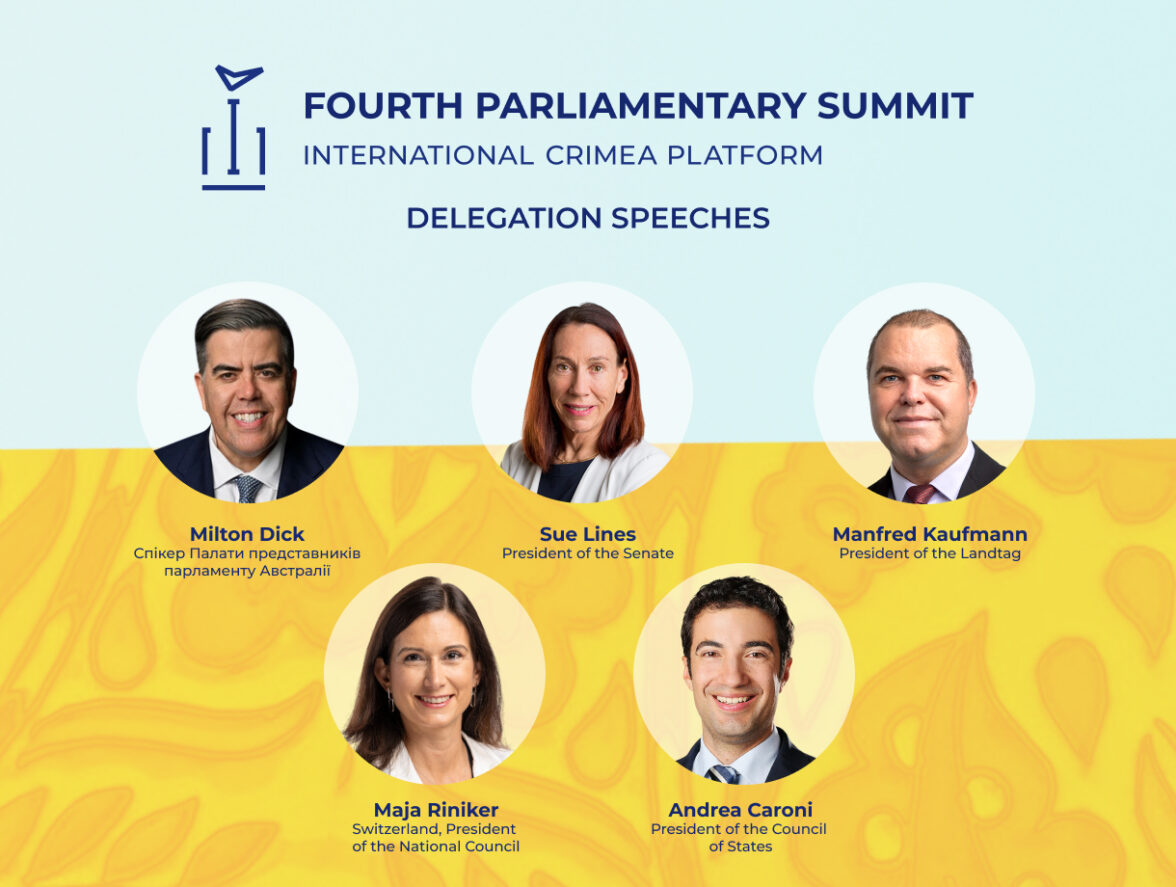
“Russia’s attempted annexation of Crimea since 2014, and now its full-scale invasion of Ukraine, demonstrates the Kremlin’s complete disregard for international law and the UN Charter, which recognizes Ukraine’s borders, including the Crimean Peninsula,” — Milton Dick, Speaker of the House of Representatives, Australia.
He also emphasized that Australia remains steadfast in its support for Ukraine and the international rules-based order. According to him, Russian aggression poses a serious threat to European security, and the meeting in Stockholm is an important signal of support for Ukraine. He noted that Australia has already provided over USD 1.3 billion in assistance, imposed more than 1,600 sanctions, and contributed to limiting Russia’s revenue. Milton Dick stressed that Australia will continue working with partners to achieve a just peace, adding that the international community must remain united to ensure aggression is never more rewarding than peace.
“Russia must immediately, completely and unconditionally withdraw its troops from within the internationally recognised borders of Ukraine, including the Crimean Peninsula. Our response as parliamentarians must be steadfast — words are not enough. Australia stands with Ukraine and will continue to provide strong and unwavering support for as long as it takes,” — Sue Lines, President of the Senate, Australia.
She highlighted that the Crimea Platform is an essential forum for holding Russia accountable for the occupation of Crimea and underscores the role of parliaments as bearers of democratic legitimacy and solidarity. According to her, Ukraine’s struggle is a defense of the principle that force cannot determine what is right, and the international community must increase pressure on those who support aggression and pursue justice through international courts. She added that Russian aggression will not prevail and that Ukraine’s sovereignty will be restored.
“Russia continues to commit massive violations of international law, in particular by deliberately targeting civilians and civilian infrastructure, which is absolutely unacceptable,” said Manfred Kaufmann, Liechtenstein, President of the Landtag.
He noted that his country has consistently and fully implemented all EU sanctions against Russia and Belarus in response to their aggression against Ukraine and continues to firmly condemn the illegal occupation of Crimea and other Ukrainian territories. According to him, lasting peace will be possible only when Russia is held accountable for the crime of aggression, and the agreement between the Council of Europe and Ukraine on a special tribunal is an essential step toward that goal.
“I was deeply moved by the fate of the Ukrainian children who were illegally deported by Russia. These children were taken from their homes, their families, and their communities. The abduction of children is not only a profound injustice — it is a crime. A crime against the future of a nation,” said Maja Riniker, Switzerland, President of the National Council.
She stressed that Russia’s actions, including the occupation of Crimea and attacks across the entire territory of Ukraine, constitute a grave and ongoing violation of international law. She underlined that the Ukrainian people are paying an exceptionally high price to defend principles essential for all of Europe, and reminded that a genuine and lasting peace is impossible without Ukraine at the negotiation table.
“Ukrainian craftsmen trained in Switzerland are continuing this work — building prefabricated wooden houses for families who have lost their homes. Seeing new walls rise while the threat of drones and missiles still hangs overhead is a powerful sign of support. This is only one of many initiatives that demonstrate Switzerland’s presence in Ukraine,” said Andrea Caroni, President of the Council of States.
Andrea Caroni emphasized that his country will continue to support humanitarian programs, demining efforts, and reconstruction projects, including school shelters that already allow thousands of Ukrainian children to study in safety. He added that the responsibility of democratic states lies not only in responding to the current challenges of the war, but also in ensuring a just peace and Ukraine’s future recovery.