10 June 2025
An Article About Crimean Political Prisoners Is Published in the Newsweek Polska
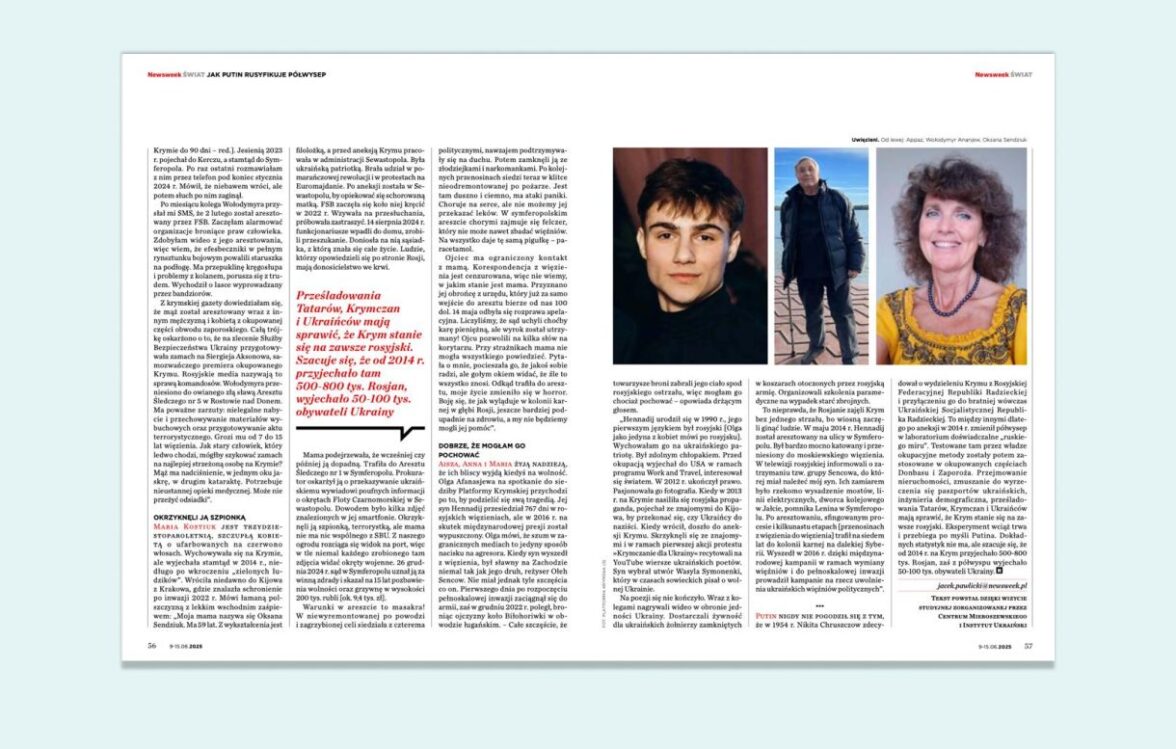
In May, the Mission hosted a delegation of Polish journalists organized by the Meroszewski Center in cooperation with the Ukrainian Institute, which met with relatives of political prisoners. This event inspired a poignant and at the same time research publication “Crimean prisoners. ‘Mom suspected that sooner or later they would get her’” (Więźniowie krymscy. “Mama podejrzewała, że wcześniej czy później ją dopadną”) for Newsweek Polska, in which the famous Polish reporter Jacek Pawlicki tells the stories of Crimean political prisoners who became symbols of the Russian campaign of repression on the occupied peninsula.
The text captures the voices of Aisha Kurtamet, Anna Sviatnenko, Maria Kostiuk, and Olga Afanasieva — women whose sons, husbands, and mothers were unjustly imprisoned for their refusal to submit to Russian occupation. Among them are Appaz Kurtamet, sentenced for a money transfer to a friend; 75-year-old Volodymyr Ananiev, accused of terrorism; Oksana Senedzhuk, sentenced to 15 years for photos on her phone; and the late Hennadii Afanasiev, released from prison in 2016 and later killed in action defending Ukraine.
This reportage reflects the grim reality of systemic repression, fabricated trials, and ideological colonization orchestrated by the occupying authorities in Crimea — a pattern now replicated across other Russian-occupied territories. As emphasized in the article, the stories of political prisoners are being followed by the Crimea Platform, a Ukrainian diplomatic initiative launched in 2021 to consolidate international efforts for the de-occupation of Crimea and the protection of human rights.
According to Olha Kuryshko, Permanent Representative of the President of Ukraine in Crimea, there are currently 222 political prisoners from Crimea — 133 of them are Crimean Tatars. Arrested on occupied territory, many are serving unjust sentences in Russia. Their stories — like those of Appaz Kurtamet, Volodymyr Ananiev, and Oksana Senedzhuk — reveal the brutal mechanics of repression used to silence dissent and erase Ukrainian identity.
“Giving up Crimea would mean burying the future of the Ukrainian state and consenting to the destruction of the Crimean Tatar people,” said Refat Chubarov, Head of the Mejlis, the representative body of the Crimean Tatar people, which has been outlawed by Russia as an “extremist organization.”