28 April 2026
Weekly update on the situation in occupied Crimea on April 28, 2026
Main News of the Week
▶ The General Staff of the Armed Forces of Ukraine reported hitting a P-18 radar station in the Yevpatoriia area. Also this week, the Ukrainian Security and Defense forces struck a warship traffic control point of the Russian Black Sea Fleet near Sevastopol.
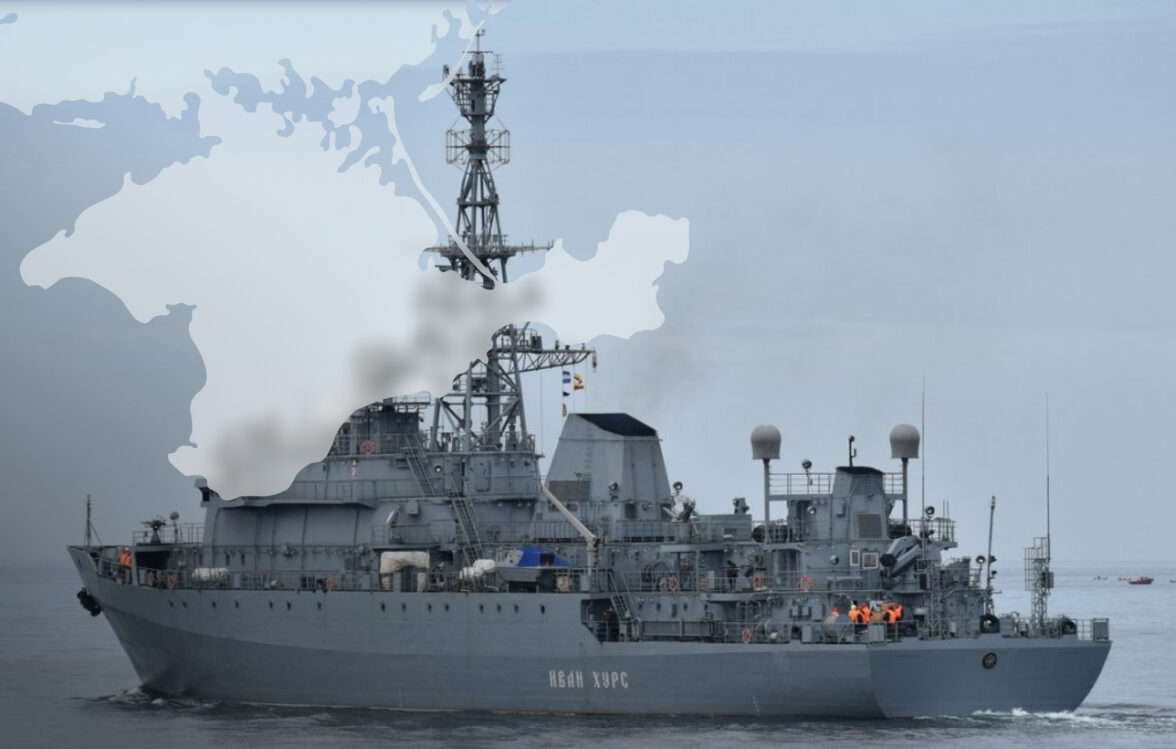
▶ In addition to last week’s strikes, the Security Service of Ukraine (SBU) struck: the Ivan Khurs reconnaissance ship, the Lukomka training center of the Russian Black Sea Fleet, a signals intelligence (SIGINT) headquarters of the air defense forces, a MiG-31 aircraft at the Belbek airfield, and the technical-operational unit of the Belbek airfield.
▶ The National Resistance Center reported a worsening environmental situation: a fuel oil spill occurred on the southern coast of Crimea. As a result, an oil film formed on the sea surface, blocking oxygen access and leading to massive poisoning of marine flora and fauna.
▶ An exhibition titled “Growing up waiting for father” opened at the Berlin Wall Museum at Checkpoint Charlie. It is dedicated to 16 children from Crimea living without their fathers, who were sentenced by the occupation administration in fabricated and politically motivated cases of political persecution.
▶ Berit Lindeman, Secretary General of the Norwegian Helsinki Committee, became a mentor for political prisoner Ruslan Suleymanov. The man was detained in 2019 and is currently held in Correctional Colony No. 17 in Murmansk for the so-called involvement in a terrorist organization and the so-called violent seizure of power.
▶ As part of the 20th package of anti-Russian sanctions, the EU introduced restrictions against the First Deputy Minister of Culture of the Russian Federation Sergey Obryvalin, the Director of the Hermitage Mikhail Piotrovsky, and the Director of the Russian Institute of Archaeology Nikolai Makarov. They are involved in the appropriation of Ukrainian cultural property in Crimea and illegal archaeological excavations.
▶ Russia continues to use the Artek camp as a tool of ideological influence on foreign youth. Specifically, the Russian invaders involve them in sessions where a distorted history is imposed. The stay itself is funded by Russian state grants and the network of “Russian Houses” abroad.
Crimes Committed by the Russian Federation
▶ As of April 23, 2026, 303 people in the territory of occupied Crimea are subject to the policy of political persecution, 164 of whom are Crimean Tatars and 1 is a Karaite.
▶ The occupation administration will try Ukrainian citizen Oleg Prykhodko in a fabricated case of the so-called promotion of terrorism and the so-called incitement to state treason. He was detained in 2019 for the alleged preparation of a terrorist attack. During his detention, he was tortured, including with electric shocks, deprived of medical assistance, and regularly sent to a punishment cell (SHIZO). In March 2026, he was transferred to SIZO No. 1 in the Russian city of Krasnodar.
▶ A Russian court extended the defendants’ detention for the so-called fifth Bakhchysarai group, namely six Crimean Tatars: Remzi Nimetullaiev, Ruslan Asanov, Ametkhan Umerov, Seidamet Mustafaiev, Eldar Yakubov, and Abdulmedzhit Seiumerov. All are accused in a fabricated case of involvement in the Hizb ut-Tahrir organization. The next court hearing is scheduled for May 25. In August 2023, their homes were searched, and in the summer of 2024, they were moved from Simferopol SIZO No. 2 to the Russian Federation.
▶ The health of political prisoner Rustem Sheikhaliev has deteriorated. Specifically, the man suffers from varicose veins, severe headaches, hypertension, and dental problems. He is being held in Correctional Colony No. 3 in the Amur region of Russia. In 2022, he was accused of the so-called terrorism and sentenced to 14 years in prison.
The use of occupied Crimea as a springboard for attacks on Ukraine and the militarization of the peninsula
Since Russia launched a full-scale invasion and spread its armed aggression throughout Ukraine, occupied Crimea has been used by Russia as a military base for spreading aggression in various forms. From the peninsula, the Russian invaders continue to launch attacks on the territory of Ukraine, including on civilian infrastructure.
▶ The Air Force of the Armed Forces of Ukraine reported that the Russian invaders carried out another series of massive combined attacks on the territory of Ukraine during the week. In particular, they launched over 1,100 strike UAVs of the Shahed, Gerbera, and Italmas types, and 12 Iskander-M/S-400 ballistic missiles, including from the territory of occupied Crimea and the Black Sea.
▶ The monitoring group Crimean Wind recorded the presence of three Project 22460 Okhotnik ships of the FSB Border Service in the Inkerman Bay of Sevastopol. The group also reported a bulk carrier positioned near the Alvita grain terminal, which may likely be involved in the theft of Ukrainian grain.
The resistance movement of Ukrainian citizens in occupied Crimea
▶ Activists of the Yellow Ribbon movement reported that the Russian Federation systematically uses education as a tool of ideological influence on children. Specifically, the occupation administration implements the Orlyata of Russia program, through which so-called traditional values are imposed on children, who are later recruited into organizations controlled by the Russian invaders. Activists also recorded an intensified recruitment campaign for the Russian occupation army among the youth.
The full-scale invasion was marked by a sharp increase in acts of solidarity and resistance by the residents of occupied Crimea against the Russian invaders. Residents of the occupied territories unite in resistance movements, such as Yellow Ribbon, Zla Mavka, and ATESH, or act individually.
To suppress the resistance movement of local residents in the temporarily occupied territory of Crimea after February 24, 2022, the occupation administration actively began to persecute and bring Ukrainian citizens to administrative liability under the article on the so-called discrediting the Russian army.
De-occupation of Crimea is an integral part of ending the war and restoring peace. Ukrainians are doing everything possible to stop the aggressor and protect the entire world from Russia’s criminal actions. Since this is not a local or regional problem, Russia’s aggression poses a threat to the entire world and the international order.