17 June 2026
Weekly update on the situation in occupied Crimea on June 17, 2026
Main News of the Week
▶ On the night of June 11, units of the Ukrainian Defense Forces struck a storage facility for unmanned aerial vehicles near the village of Hryhorivka and a facility for the production and outfitting of unmanned naval vessels in Sevastopol. At the same time, the military also launched a missile strike using the Neptune coastal missile system against an occupiers’ military facility in Striletska Bay in Sevastopol.
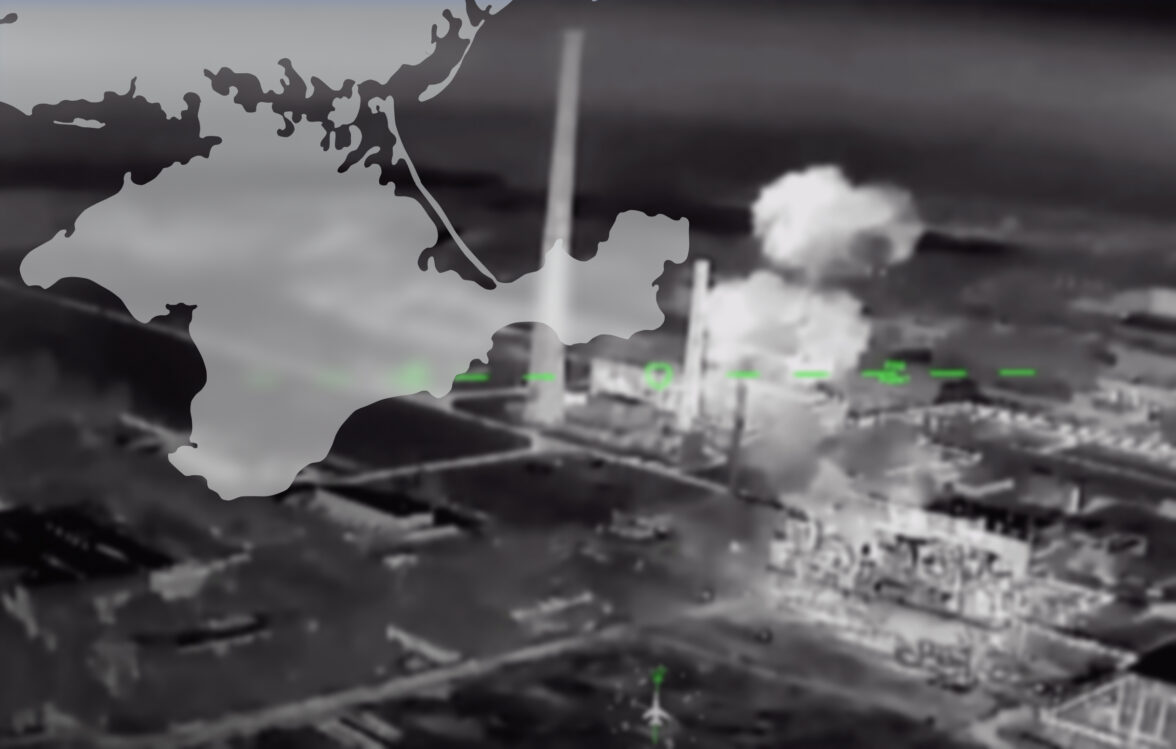
▶ On the night of June 13, the Ukrainian Unmanned Systems Forces struck the Crimean Titan, the largest plant of its kind in Eastern Europe, in the temporarily occupied city of Armiansk. The strike caused a fire, and production was suspended.
▶ The President of Ukraine imposed sanctions against 29 individuals and 17 legal entities, including judges involved in the criminal prosecution of Ukrainians in Russia and in the temporarily occupied Crimea, as well as in the in absentia conviction of Ukrainian activists, journalists, and politicians.
Crimes Committed by the Russian Federation
▶ As of June 16, 2026, 303 people in the territory of occupied Crimea are subject to the policy of political persecution, 164 of whom are Crimean Tatars and 1 is a Karaite.
▶ As of May 18, 2026, 1,752 cases have been recorded on the territory of the temporarily occupied Crimea with charges under Article 20.3.3 of the Code of Administrative Offenses of the Russian Federation regarding the so-called discrediting of the Armed Forces of the Russian Federation. In 1,630 cases, a fine was imposed or the case was consolidated with another proceeding under a different article, resulting in a combined ruling. In 8 cases, proceedings are still ongoing. In 53% of the rulings (861), the defendants were women; in 47% (767), they were men.
▶ Political prisoner Oleksandr Sizikov, sentenced by the occupiers to 17 years in prison, was transferred from the Minusinsk prison in the Russian Federation to the Krasnoyarsk Regional Tuberculosis Hospital to undergo rehabilitation program, as reported by his wife, Olena Sizikova.
▶ Political prisoner Anatoliy Kobzar has been diagnosed with Ménière’s disease – a chronic disease of the inner ear. It can lead to sudden attacks of severe dizziness, loss of balance, hearing loss, and constant tinnitus in the ears. The occupiers detained Kobzar in 2024 and charged him with “treason” in a fabricated case. He is currently being held behind bars, though no verdict has yet been handed down. He faces up to 20 years in prison. During his unlawful detention, he has already lost about 40 kilograms.
▶ The occupiers extended the detention of four women involved in the “Bakhchisaray Women’s Group” until September 14. These are Esma Nimetulaieva, Nasiba Saidova, Elviza Aliieva, and Fevziie Osmanova, whom the occupiers detained on October 15, 2025. They were accused of participating in the organization Hizb ut-Tahrir, which Russia designated as a “terrorist” organization and banned in 2003, and after the occupation of Ukrainian territories, illegally extended its legislation to those territories.
▶ Serhiy Hrishchenkov, an IT specialist from Sevastopol who was abducted by the occupiers in May 2025, has officially been ordered to remain in custody until August 4, 2026. He is accused of “treason”, but the evidence of his alleged guilt may have been obtained under torture. The Russian FSB have been denying any involvement in Hrishchenkov’s disappearance, while the military prosecutor’s office refused to open or investigate a criminal case regarding his enforced disappearance.
▶ Political prisoners Raim Aivazov and Ruslan Nagaiev, convicted in the Hizb ut-Tahrir cases, were transferred from Penal Colony No. 21 in the village of Iksa, Arkhangelsk Oblast, to Penal Colony No. 4 in the city of Kotlas in the same region. The occupiers detained the men in 2019 following mass searches of Crimean Tatar homes. Subsequently, the occupiers sentenced Raim Aivazov, an activist from the Simferopol district, to 17 years in prison, while Ruslan Nagaiev, a resident of Alushta, was sentenced to 13 years.
▶ Political prisoner Vladlen Abdulkadyrov, who was sentenced to 12 years in prison, was hospitalized from Penal Colony No. 21 in the Arkhangelsk Region, where he was serving his unlawful sentence. According to his wife, the activist’s condition worsened due to a previously diagnosed intervertebral hernia and vertebral displacement. She said he has been experiencing back problems since 2023. While in custody, he began experiencing pain in his right leg and numbness in his fingers. At the hospital, Abdulkadyrov was given injections, which caused his blood pressure to rise. He is currently taking painkillers, but they provide only minimal relief.
The use of occupied Crimea as a springboard for attacks on Ukraine and the militarization of the peninsula
Since Russia launched a full-scale invasion and spread its armed aggression throughout Ukraine, occupied Crimea has been used by Russia as a military base for spreading aggression in various forms. From the peninsula, the occupiers continue to launch attacks on the territory of Ukraine, including on civilian infrastructure.
▶ The Ukrainian Air Force reported that during the past week, the occupiers carried out another series of massive combined attacks on Ukrainian territory. In particular, they launched more than 1,500 strike UAVs of the Shahed, Gerbera, and Italmas types, as well as “Parodia” decoy drones, from various directions, including from the territory of occupied Crimea and the Black Sea. At the same time, the Russians launched six 3M22 Zircon anti-ship missiles at Ukraine from the territory of occupied Crimea.
▶ The Russians continue to militarize young people in Crimea. Specifically, in the Kurman district of Crimea, the Russians held military training exercises for 10th-grade schoolchildren, during which military personnel of the so-called special military operation taught the youth tactical and combat training, grenade throwing, first aid, and more.
The resistance movement of Ukrainian citizens in occupied Crimea
▶ Activists of the Yellow Ribbon report that Russian military forces have begun camouflaging fuel tankers on roads leading to Crimea and on the peninsula itself. They are repainting the tankers or altering their appearance to resemble civilian trucks by erecting wooden structures on top of them. Such camouflage increases risks to civilians and indicates attempts to conceal military logistics among ordinary infrastructure.
▶ Agents of the Atesh movement have documented the Russians’ deployment of mobile fire teams – specifically, armed pickup trucks and vehicles equipped with machine guns – to Chongar and bridges in Crimea.
▶ The occupiers plan to put a Crimean resident on trial on charges of inciting “extremism” on social media, specifically for posts allegedly calling for violent actions against a group of people based on their nationality.
The full-scale invasion was marked by a sharp increase in acts of solidarity and resistance by residents of occupied Crimea against the Russian occupiers. Residents of the occupied territories are uniting in resistance movements such as “Yellow Ribbon”, “Zla Mavka”, and “ATESH”, or acting individually.
To suppress the resistance movement of local residents in the temporarily occupied territory of Crimea after February 24, 2022, the occupation administration actively began to persecute and bring Ukrainian citizens to administrative liability under the article on the so-called discreditation of the Russian army.
De-occupation of Crimea is an integral part of ending the war and restoring peace. Ukrainians are doing everything possible to stop the aggressor and protect the entire world from Russia’s criminal actions. Since this is not a local or regional problem, Russia’s aggression poses a threat to the entire world and the international order.