17 September 2025
The occupiers held another pseudo-election in Crimea
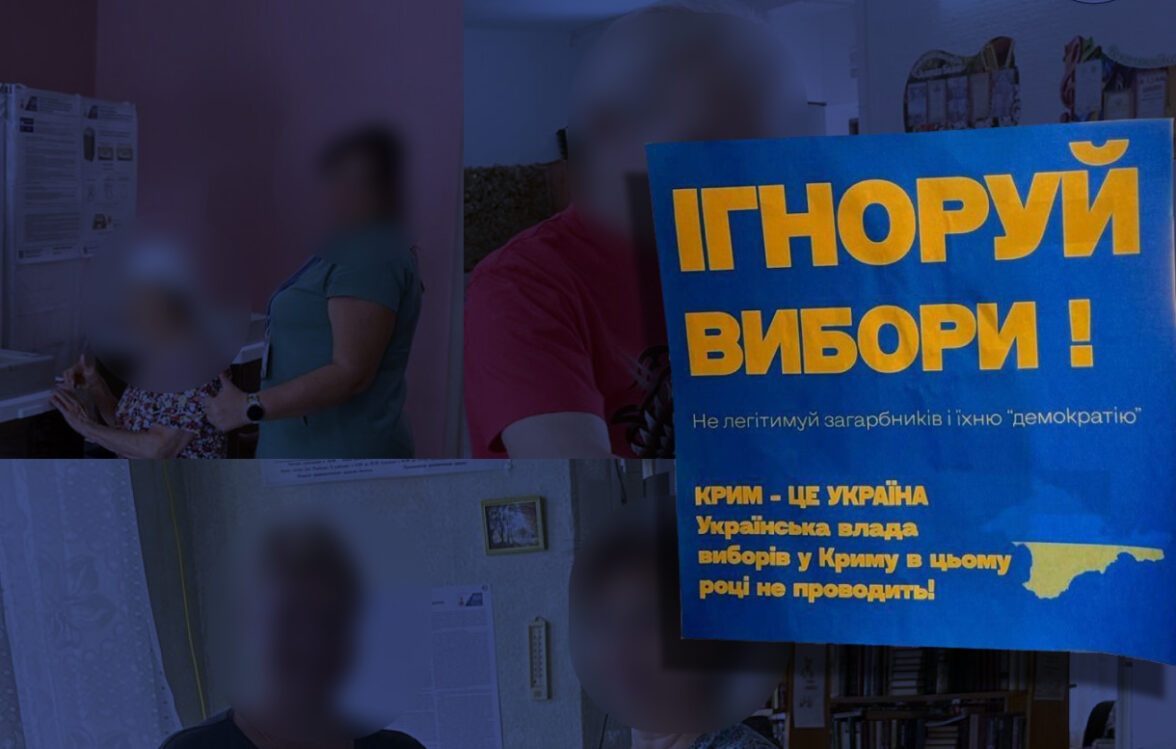
In September 2025, Russia conducted another round of sham “elections” in the temporarily occupied territory of the Autonomous Republic of Crimea and the city of Sevastopol. This is a gross violation of international law – including the UN Charter, the Helsinki Final Act, and the Fourth Geneva Convention of 1949 – which prohibits an occupying power from changing the political status of occupied territory or organizing any “elections” under coercion. Any such “expression of will” organized by the occupation administration is legally null and void and creates no consequences for Ukraine’s sovereignty over Crimea.
Despite intense pressure and propaganda from Moscow, the majority of Crimean residents pointedly ignored this theatrical vote. At the early “voting” stage (September 3–11) in Sevastopol, only 127,608 people participated – around 37% of the city’s total number of voters. This meager turnout was the first sign of the Kremlin’s scenario failing.
During the three days of the main “voting” (September 12–14), polling stations remained virtually empty. Even Russian propagandist media managed to capture only a few pensioners at the polls, whom the occupation administration had coaxed with promises of minor everyday “improvements.”
To at least somehow increase turnout, the occupiers set up a total of 187 polling stations, including temporary ones – even in City Hospital No. 1 and aboard vessels of the occupiers’ naval forces. Moreover, extraterritorial polling stations were created: 14 in Moscow and another 4 in the combat zone of other occupied territories of Ukraine. Thus, the occupation administration attempted to artificially inflate the turnout by pulling in votes from outside Crimea and creating an illusion of mass participation.
Even those few “voters” who did show up at the polling stations were mostly settlers brought in by Russia during the years of occupation, rather than native residents of the peninsula.
To create a deceptive appearance of “transparency” in the process, the Russians deployed nearly 700 “observers” completely controlled by the occupation administration. Notably, 494 of them were representatives of candidates from pro-Kremlin parties and pseudo-associations, and another 189 were delegates of the so-called “Public Chamber of Sevastopol.” In reality, the entire process was under the invaders’ full control and accompanied by massive fraud.
Activists report that ballots were being stuffed en masse into ballot boxes to simulate the desired results – to such an extent that the vote count likely wasn’t conducted at all. Notably, in Sevastopol over 60% of ballots ended up not in stationary ballot boxes, but in portable boxes intended for voting at home or outside polling stations. In total, about 155,000 ballots were collected in portable boxes versus only 83,600 in stationary boxes. Thus, the bulk of the “turnout” was provided through uncontrolled procedures, further proving the fictitious nature and complete lack of legitimacy of this farce.
To hide these violations from the world and from Crimeans themselves, the occupation administration even partially restricted internet service across the peninsula during the “elections,” so that residents could not monitor or report the numerous instances of falsification. In addition, in Sevastopol they sharply increased the number of patrols, deploying many times more of the occupiers’ security forces on the streets than usual – underscoring the panic and fear of the Russian authorities in the face of potential actions by the Ukrainian underground resistance.
Meanwhile, the residents of Crimea demonstrated a mass boycott of this farce. The Yellow Ribbon resistance movement initiated a civil disobedience campaign called SevasIgnore, openly urging Sevastopol residents not to come to the polling stations at all. A specially launched web counter allowed anyone to anonymously “register” their no-show in the pseudo-elections – and tens of thousands of people took advantage of this opportunity. By the end of the voting, over 51,000 residents of Sevastopol had marked their participation in the boycott.
Ukraine and the international community unanimously declared they do not recognize these illegal “elections.” The Ministry of Foreign Affairs of Ukraine emphasized that any voting organized by Russia on occupied territory is unlawful, and the results obtained are null and void. The “voting” carried out by the occupiers remains a political performance with no legal consequences – and a vivid testament to the dedication of Crimea’s residents, who ultimately, through their boycott, foiled the occupiers’ latest attempt to legitimize their crime.