25 April 2025
At Harvard University, the anthology of Crimean Tatar poetry Crimean Fig: An Anthology of Contemporary Crimean Tatar Writing was presented
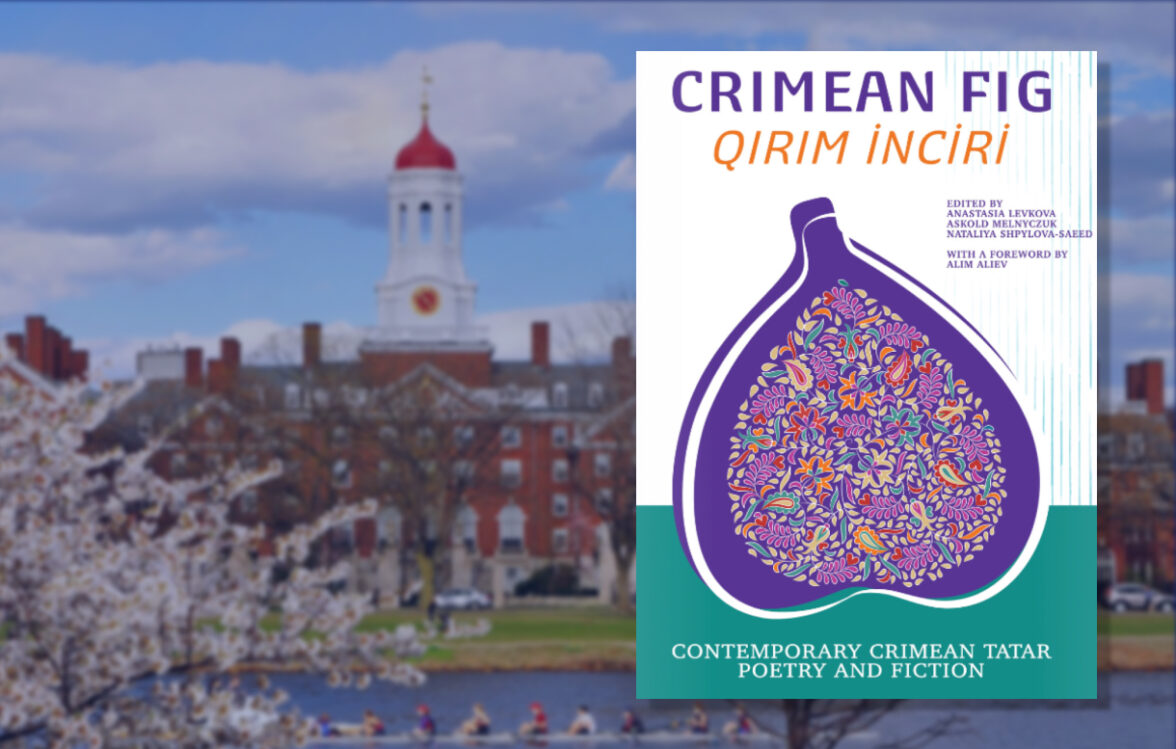
On April 22, an online discussion was held to mark the launch of the first English-language anthology of contemporary Crimean Tatar poetry and prose, Crimean Fig: An Anthology of Contemporary Crimean Tatar Writing. This publication is the result of translations of texts originally published within the Ukrainian cultural project Crimean Fig / Qırım inciri. The event was organized by the Davis Center for Russian and Eurasian Studies at Harvard University, the Ukrainian Research Institute at Harvard, and Arrowsmith Press.
The discussion featured Alim Aliev, co-founder of the Crimean Fig literary project, publicist, human rights defender, and Deputy Director General of the Ukrainian Institute; Anastasia Levkova, co-founder of Crimean Fig, Ukrainian writer, journalist, and cultural manager; Rory Finnin, Professor of Ukrainian Studies at the University of Cambridge and expert on literary decolonization; Serhii Plokhii, Professor of History and Director of the Ukrainian Research Institute at Harvard University; Askold Melnyczuk, publisher of the anthology, founder of Arrowsmith Press, and Professor of English at the University of Massachusetts Boston. The event was moderated by Nataliya Shpylova-Saeed, Ukrainian language instructor in the Department of Slavic Languages and Literatures at Harvard University.
The speakers focused on how, despite Crimea’s regular presence in global news, it remains an unknown land for many. It has a multi-layered history — from Herodotus and the poets of Romanticism to the Yalta Conference, which helped shape the post-World War II order. Yet behind these grand narratives of empires, the story of Ukraine’s Indigenous people — the Crimean Tatars — is often overlooked.
Particular attention was given to the themes of loss and restoration. Following Stalin’s 1944 deportation, Crimea was left without its Crimean Tatar population for the first time in centuries. With Ukrainian independence, their return began; however, the 2014 occupation once again turned them into strangers in their own homeland. And yet, as the participants noted, resistance did not disappear — it transformed into culture, into literature, which became a way of preserving their voice.
In his remarks, Rory Finnin emphasized the importance of Crimean Tatar literature as an alternative source of knowledge that goes beyond familiar imperial narratives:
“When we focus on Crimean Tatar literature, we often find ourselves outside the imperialist imagination of the Kremlin. I believe that this approach to studying Crimean Tatar voices offers us a methodology of decolonization, which I see as especially relevant today.”
Alim Aliev stressed that the present moment is a time for reclaiming voices, names, and history from one’s own perspective:
“Today, we are decolonizing the knowledge about ourselves. We will discuss the history of the peninsula from our own perspective. We are living in an era when we are reclaiming our names. And for the Crimean Tatars, this is also an important process.”
Anastasiia Levkova highlighted that the publication of an English-language anthology is an important step toward global recognition of Crimean Tatar literature:
“If today we are presenting an anthology of Crimean Tatar texts translated into English and published in America, it means that Crimean Fig has become a gateway for Crimean Tatar literature to reach the world beyond Ukraine.”
Askold Melnyczuk emphasized that, for him as an editor, this anthology is above all an opportunity to personally discover a new literary tradition:
“The contemporary work of [Crimean Tatar] writers and intellectuals has rarely been translated. As an editor, I saw this as a wonderful opportunity to learn; for me, this project is above all a way to discover what I did not know, to find a literature that is important but has largely been overlooked.”
The presentation of the Crimean Fig anthology underscored the need for broader inclusion of Crimean Tatar poetry and prose in international cultural exchange. This literature creates its own space of identity, engaging with experiences of loss, resistance, and return. International cooperation is a means of ensuring the presence of Crimean Tatar voices in the global context. It paves the way for a more attentive re-examination of the history, literature, and society of the peninsula.