24 November 2025
Within the framework of the Fourth Parliamentary Summit of the Crimea Platform, delegations from Bulgaria, Estonia, Portugal, Finland, Germany, NATO Parliamentary Assembly delivered speeches
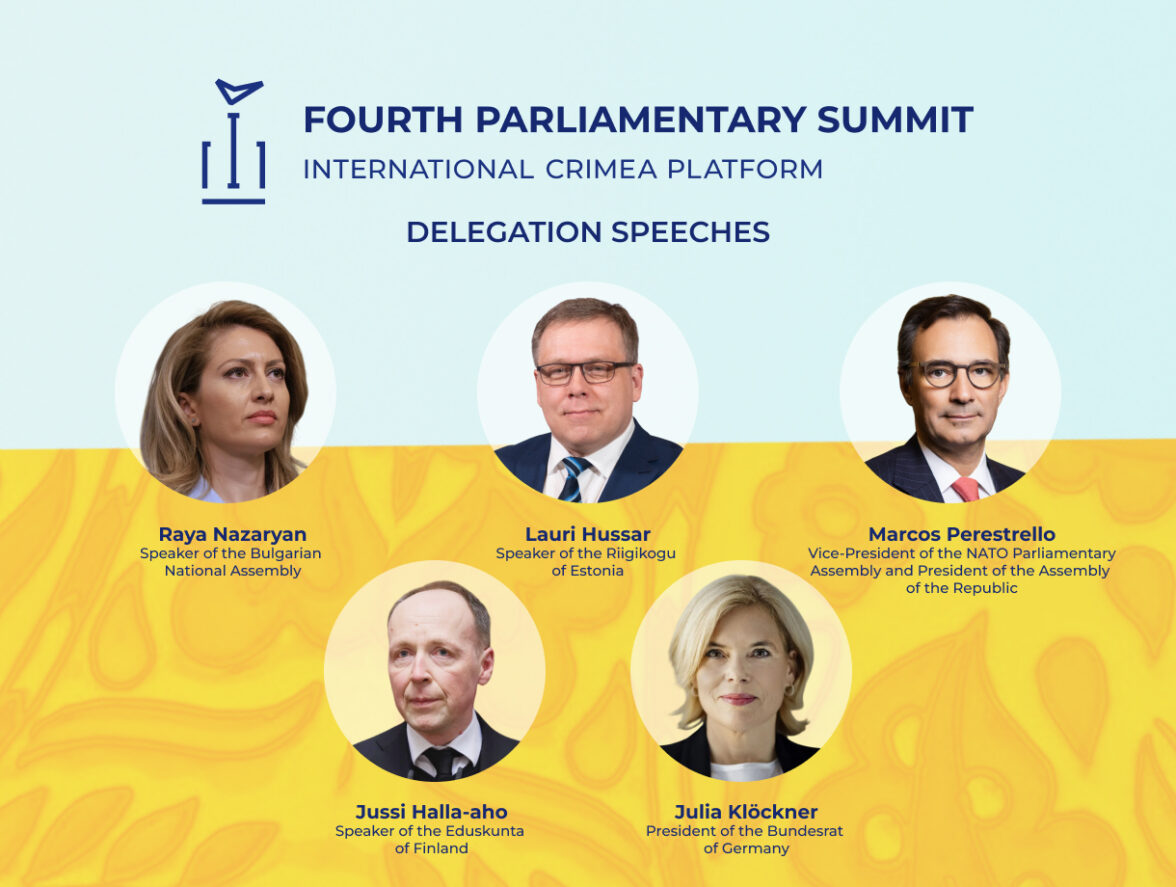
“The war started with the illegal annexation of Crimea in 2014, not in 2022. The return of the occupied territories is a matter not only of the rule of law but also of international legal principles.” — Raya Nazaryan, Speaker of the Bulgarian National Assembly.
In her address, Ms. Nazaryan emphasized the Ukrainian people’s sovereign right to independently define their future and determine the terms of a peace agreement. She added that the current shared goal is the peaceful and sustainable development of Ukraine and noted that its reconstruction is no longer a future ambition, but a present choice that serves the interests of both the Ukrainian people and the entire European Union.
“Let Europe stand united and resolute, ensuring that peace is built on Ukraine’s courage and rests upon justice, law, and lasting security. If territories can be gained by force, no one is secure.” — Lauri Hussar, Speaker of the Riigikogu of Estonia.
Mr. Hussar warned that history demonstrates that concessions made to Russia merely encourage further aggression and underscored that any agreement must focus on ending the war, securing Ukraine’s future, and providing credible security guarantees. He concluded by noting that the present moment is decisive not only for Ukraine but for the fate of all Europe.
“We can have no illusions: Russia is and will remain a threat to NATO and Euro-Atlantic security, and any potential political settlement must lead to an end of its pattern of aggressive behavior.” — Marcos Perestrello, Vice-President of the NATO Parliamentary Assembly and President of the Assembly of the Republic of Portugal.
Mr. Perestrello affirmed Portugal’s consistent support for Ukraine and its condemnation of the Russian invasion. He recalled that the NATO Parliamentary Assembly demonstrated a clear stance from the very start of the Russian aggression: it became one of the first international institutions to expel/remove the Russian delegation after the occupation of Crimea. The Speaker concluded by strongly urging allies, on behalf of the NATO Parliamentary Assembly, to facilitate Ukraine’s accession to NATO.
“A Russian success in Ukraine would send a very dangerous message to every other country that aggression is rewarded by the world,” — Jussi Halla-aho, Speaker of the Eduskunta of Finland.
Mr. Halla-aho stated that illusions regarding Russia’s actions must be discarded, emphasizing that Europe should focus on its own capability and willingness to act. He cautioned that Russia’s long-term policy is dangerous for Ukraine, and will subsequently become even more perilous for everyone else.
“Europe will not waver and will continue its support for Ukraine. Our task now is not to divide Europe, but to strengthen its unity.” — Julia Klöckner, President of the Bundesrat of Germany.
Ms. Klöckner stressed that the moral aspect of the conflict is evident and expressed concern that some governments are questioning or slowing down decisions on sanctions and arms supplies to Ukraine. She declared that territorial integrity and state sovereignty are non-negotiable and urged those countries that have taken a different course to return to the table of consensus.